

-
1 последующий
1. subsequent payment2. consequential3. consequentual4. ensuing5. later6. subsequentпоследующий; дополнительный платеж — subsequent payment
7. succedent8. succeeding9. supervening10. following11. after12. posterior13. successiveАнтонимический ряд: -
2 последующая фаза
Military: later phase -
3 Historical Portugal
Before Romans described western Iberia or Hispania as "Lusitania," ancient Iberians inhabited the land. Phoenician and Greek trading settlements grew up in the Tagus estuary area and nearby coasts. Beginning around 202 BCE, Romans invaded what is today southern Portugal. With Rome's defeat of Carthage, Romans proceeded to conquer and rule the western region north of the Tagus, which they named Roman "Lusitania." In the fourth century CE, as Rome's rule weakened, the area experienced yet another invasion—Germanic tribes, principally the Suevi, who eventually were Christianized. During the sixth century CE, the Suevi kingdom was superseded by yet another Germanic tribe—the Christian Visigoths.A major turning point in Portugal's history came in 711, as Muslim armies from North Africa, consisting of both Arab and Berber elements, invaded the Iberian Peninsula from across the Straits of Gibraltar. They entered what is now Portugal in 714, and proceeded to conquer most of the country except for the far north. For the next half a millennium, Islam and Muslim presence in Portugal left a significant mark upon the politics, government, language, and culture of the country.Islam, Reconquest, and Portugal Created, 714-1140The long frontier struggle between Muslim invaders and Christian communities in the north of the Iberian peninsula was called the Reconquista (Reconquest). It was during this struggle that the first dynasty of Portuguese kings (Burgundian) emerged and the independent monarchy of Portugal was established. Christian forces moved south from what is now the extreme north of Portugal and gradually defeated Muslim forces, besieging and capturing towns under Muslim sway. In the ninth century, as Christian forces slowly made their way southward, Christian elements were dominant only in the area between Minho province and the Douro River; this region became known as "territorium Portu-calense."In the 11th century, the advance of the Reconquest quickened as local Christian armies were reinforced by crusading knights from what is now France and England. Christian forces took Montemor (1034), at the Mondego River; Lamego (1058); Viseu (1058); and Coimbra (1064). In 1095, the king of Castile and Léon granted the country of "Portu-cale," what became northern Portugal, to a Burgundian count who had emigrated from France. This was the foundation of Portugal. In 1139, a descendant of this count, Afonso Henriques, proclaimed himself "King of Portugal." He was Portugal's first monarch, the "Founder," and the first of the Burgundian dynasty, which ruled until 1385.The emergence of Portugal in the 12th century as a separate monarchy in Iberia occurred before the Christian Reconquest of the peninsula. In the 1140s, the pope in Rome recognized Afonso Henriques as king of Portugal. In 1147, after a long, bloody siege, Muslim-occupied Lisbon fell to Afonso Henriques's army. Lisbon was the greatest prize of the 500-year war. Assisting this effort were English crusaders on their way to the Holy Land; the first bishop of Lisbon was an Englishman. When the Portuguese captured Faro and Silves in the Algarve province in 1248-50, the Reconquest of the extreme western portion of the Iberian peninsula was complete—significantly, more than two centuries before the Spanish crown completed the Reconquest of the eastern portion by capturing Granada in 1492.Consolidation and Independence of Burgundian Portugal, 1140-1385Two main themes of Portugal's early existence as a monarchy are the consolidation of control over the realm and the defeat of a Castil-ian threat from the east to its independence. At the end of this period came the birth of a new royal dynasty (Aviz), which prepared to carry the Christian Reconquest beyond continental Portugal across the straits of Gibraltar to North Africa. There was a variety of motives behind these developments. Portugal's independent existence was imperiled by threats from neighboring Iberian kingdoms to the north and east. Politics were dominated not only by efforts against the Muslims inPortugal (until 1250) and in nearby southern Spain (until 1492), but also by internecine warfare among the kingdoms of Castile, Léon, Aragon, and Portugal. A final comeback of Muslim forces was defeated at the battle of Salado (1340) by allied Castilian and Portuguese forces. In the emerging Kingdom of Portugal, the monarch gradually gained power over and neutralized the nobility and the Church.The historic and commonplace Portuguese saying "From Spain, neither a good wind nor a good marriage" was literally played out in diplomacy and war in the late 14th-century struggles for mastery in the peninsula. Larger, more populous Castile was pitted against smaller Portugal. Castile's Juan I intended to force a union between Castile and Portugal during this era of confusion and conflict. In late 1383, Portugal's King Fernando, the last king of the Burgundian dynasty, suddenly died prematurely at age 38, and the Master of Aviz, Portugal's most powerful nobleman, took up the cause of independence and resistance against Castile's invasion. The Master of Aviz, who became King João I of Portugal, was able to obtain foreign assistance. With the aid of English archers, Joao's armies defeated the Castilians in the crucial battle of Aljubarrota, on 14 August 1385, a victory that assured the independence of the Portuguese monarchy from its Castilian nemesis for several centuries.Aviz Dynasty and Portugal's First Overseas Empire, 1385-1580The results of the victory at Aljubarrota, much celebrated in Portugal's art and monuments, and the rise of the Aviz dynasty also helped to establish a new merchant class in Lisbon and Oporto, Portugal's second city. This group supported King João I's program of carrying the Reconquest to North Africa, since it was interested in expanding Portugal's foreign commerce and tapping into Muslim trade routes and resources in Africa. With the Reconquest against the Muslims completed in Portugal and the threat from Castile thwarted for the moment, the Aviz dynasty launched an era of overseas conquest, exploration, and trade. These efforts dominated Portugal's 15th and 16th centuries.The overseas empire and age of Discoveries began with Portugal's bold conquest in 1415 of the Moroccan city of Ceuta. One royal member of the 1415 expedition was young, 21-year-old Prince Henry, later known in history as "Prince Henry the Navigator." His part in the capture of Ceuta won Henry his knighthood and began Portugal's "Marvelous Century," during which the small kingdom was counted as a European and world power of consequence. Henry was the son of King João I and his English queen, Philippa of Lancaster, but he did not inherit the throne. Instead, he spent most of his life and his fortune, and that of the wealthy military Order of Christ, on various imperial ventures and on voyages of exploration down the African coast and into the Atlantic. While mythology has surrounded Henry's controversial role in the Discoveries, and this role has been exaggerated, there is no doubt that he played a vital part in the initiation of Portugal's first overseas empire and in encouraging exploration. He was naturally curious, had a sense of mission for Portugal, and was a strong leader. He also had wealth to expend; at least a third of the African voyages of the time were under his sponsorship. If Prince Henry himself knew little science, significant scientific advances in navigation were made in his day.What were Portugal's motives for this new imperial effort? The well-worn historical cliche of "God, Glory, and Gold" can only partly explain the motivation of a small kingdom with few natural resources and barely 1 million people, which was greatly outnumbered by the other powers it confronted. Among Portuguese objectives were the desire to exploit known North African trade routes and resources (gold, wheat, leather, weaponry, and other goods that were scarce in Iberia); the need to outflank the Muslim world in the Mediterranean by sailing around Africa, attacking Muslims en route; and the wish to ally with Christian kingdoms beyond Africa. This enterprise also involved a strategy of breaking the Venetian spice monopoly by trading directly with the East by means of discovering and exploiting a sea route around Africa to Asia. Besides the commercial motives, Portugal nurtured a strong crusading sense of Christian mission, and various classes in the kingdom saw an opportunity for fame and gain.By the time of Prince Henry's death in 1460, Portugal had gained control of the Atlantic archipelagos of the Azores and Madeiras, begun to colonize the Cape Verde Islands, failed to conquer the Canary Islands from Castile, captured various cities on Morocco's coast, and explored as far as Senegal, West Africa, down the African coast. By 1488, Bar-tolomeu Dias had rounded the Cape of Good Hope in South Africa and thereby discovered the way to the Indian Ocean.Portugal's largely coastal African empire and later its fragile Asian empire brought unexpected wealth but were purchased at a high price. Costs included wars of conquest and defense against rival powers, manning the far-flung navel and trade fleets and scattered castle-fortresses, and staffing its small but fierce armies, all of which entailed a loss of skills and population to maintain a scattered empire. Always short of capital, the monarchy became indebted to bankers. There were many defeats beginning in the 16th century at the hands of the larger imperial European monarchies (Spain, France, England, and Holland) and many attacks on Portugal and its strung-out empire. Typically, there was also the conflict that arose when a tenuously held world empire that rarely if ever paid its way demanded finance and manpower Portugal itself lacked.The first 80 years of the glorious imperial era, the golden age of Portugal's imperial power and world influence, was an African phase. During 1415-88, Portuguese navigators and explorers in small ships, some of them caravelas (caravels), explored the treacherous, disease-ridden coasts of Africa from Morocco to South Africa beyond the Cape of Good Hope. By the 1470s, the Portuguese had reached the Gulf of Guinea and, in the early 1480s, what is now Angola. Bartolomeu Dias's extraordinary voyage of 1487-88 to South Africa's coast and the edge of the Indian Ocean convinced Portugal that the best route to Asia's spices and Christians lay south, around the tip of southern Africa. Between 1488 and 1495, there was a hiatus caused in part by domestic conflict in Portugal, discussion of resources available for further conquests beyond Africa in Asia, and serious questions as to Portugal's capacity to reach beyond Africa. In 1495, King Manuel and his council decided to strike for Asia, whatever the consequences. In 1497-99, Vasco da Gama, under royal orders, made the epic two-year voyage that discovered the sea route to western India (Asia), outflanked Islam and Venice, and began Portugal's Asian empire. Within 50 years, Portugal had discovered and begun the exploitation of its largest colony, Brazil, and set up forts and trading posts from the Middle East (Aden and Ormuz), India (Calicut, Goa, etc.), Malacca, and Indonesia to Macau in China.By the 1550s, parts of its largely coastal, maritime trading post empire from Morocco to the Moluccas were under siege from various hostile forces, including Muslims, Christians, and Hindi. Although Moroccan forces expelled the Portuguese from the major coastal cities by 1550, the rival European monarchies of Castile (Spain), England, France, and later Holland began to seize portions of her undermanned, outgunned maritime empire.In 1580, Phillip II of Spain, whose mother was a Portuguese princess and who had a strong claim to the Portuguese throne, invaded Portugal, claimed the throne, and assumed control over the realm and, by extension, its African, Asian, and American empires. Phillip II filled the power vacuum that appeared in Portugal following the loss of most of Portugal's army and its young, headstrong King Sebastião in a disastrous war in Morocco. Sebastiao's death in battle (1578) and the lack of a natural heir to succeed him, as well as the weak leadership of the cardinal who briefly assumed control in Lisbon, led to a crisis that Spain's strong monarch exploited. As a result, Portugal lost its independence to Spain for a period of 60 years.Portugal under Spanish Rule, 1580-1640Despite the disastrous nature of Portugal's experience under Spanish rule, "The Babylonian Captivity" gave birth to modern Portuguese nationalism, its second overseas empire, and its modern alliance system with England. Although Spain allowed Portugal's weakened empire some autonomy, Spanish rule in Portugal became increasingly burdensome and unacceptable. Spain's ambitious imperial efforts in Europe and overseas had an impact on the Portuguese as Spain made greater and greater demands on its smaller neighbor for manpower and money. Portugal's culture underwent a controversial Castilianization, while its empire became hostage to Spain's fortunes. New rival powers England, France, and Holland attacked and took parts of Spain's empire and at the same time attacked Portugal's empire, as well as the mother country.Portugal's empire bore the consequences of being attacked by Spain's bitter enemies in what was a form of world war. Portuguese losses were heavy. By 1640, Portugal had lost most of its Moroccan cities as well as Ceylon, the Moluccas, and sections of India. With this, Portugal's Asian empire was gravely weakened. Only Goa, Damão, Diu, Bombay, Timor, and Macau remained and, in Brazil, Dutch forces occupied the northeast.On 1 December 1640, long commemorated as a national holiday, Portuguese rebels led by the duke of Braganza overthrew Spanish domination and took advantage of Spanish weakness following a more serious rebellion in Catalonia. Portugal regained independence from Spain, but at a price: dependence on foreign assistance to maintain its independence in the form of the renewal of the alliance with England.Restoration and Second Empire, 1640-1822Foreign affairs and empire dominated the restoration era and aftermath, and Portugal again briefly enjoyed greater European power and prestige. The Anglo-Portuguese Alliance was renewed and strengthened in treaties of 1642, 1654, and 1661, and Portugal's independence from Spain was underwritten by English pledges and armed assistance. In a Luso-Spanish treaty of 1668, Spain recognized Portugal's independence. Portugal's alliance with England was a marriage of convenience and necessity between two monarchies with important religious, cultural, and social differences. In return for legal, diplomatic, and trade privileges, as well as the use during war and peace of Portugal's great Lisbon harbor and colonial ports for England's navy, England pledged to protect Portugal and its scattered empire from any attack. The previously cited 17th-century alliance treaties were renewed later in the Treaty of Windsor, signed in London in 1899. On at least 10 different occasions after 1640, and during the next two centuries, England was central in helping prevent or repel foreign invasions of its ally, Portugal.Portugal's second empire (1640-1822) was largely Brazil-oriented. Portuguese colonization, exploitation of wealth, and emigration focused on Portuguese America, and imperial revenues came chiefly from Brazil. Between 1670 and 1740, Portugal's royalty and nobility grew wealthier on funds derived from Brazilian gold, diamonds, sugar, tobacco, and other crops, an enterprise supported by the Atlantic slave trade and the supply of African slave labor from West Africa and Angola. Visitors today can see where much of that wealth was invested: Portugal's rich legacy of monumental architecture. Meanwhile, the African slave trade took a toll in Angola and West Africa.In continental Portugal, absolutist monarchy dominated politics and government, and there was a struggle for position and power between the monarchy and other institutions, such as the Church and nobility. King José I's chief minister, usually known in history as the marquis of Pombal (ruled 1750-77), sharply suppressed the nobility and theChurch (including the Inquisition, now a weak institution) and expelled the Jesuits. Pombal also made an effort to reduce economic dependence on England, Portugal's oldest ally. But his successes did not last much beyond his disputed time in office.Beginning in the late 18th century, the European-wide impact of the French Revolution and the rise of Napoleon placed Portugal in a vulnerable position. With the monarchy ineffectively led by an insane queen (Maria I) and her indecisive regent son (João VI), Portugal again became the focus of foreign ambition and aggression. With England unable to provide decisive assistance in time, France—with Spain's consent—invaded Portugal in 1807. As Napoleon's army under General Junot entered Lisbon meeting no resistance, Portugal's royal family fled on a British fleet to Brazil, where it remained in exile until 1821. In the meantime, Portugal's overseas empire was again under threat. There was a power vacuum as the monarch was absent, foreign armies were present, and new political notions of liberalism and constitutional monarchy were exciting various groups of citizens.Again England came to the rescue, this time in the form of the armies of the duke of Wellington. Three successive French invasions of Portugal were defeated and expelled, and Wellington succeeded in carrying the war against Napoleon across the Portuguese frontier into Spain. The presence of the English army, the new French-born liberal ideas, and the political vacuum combined to create revolutionary conditions. The French invasions and the peninsular wars, where Portuguese armed forces played a key role, marked the beginning of a new era in politics.Liberalism and Constitutional Monarchy, 1822-1910During 1807-22, foreign invasions, war, and civil strife over conflicting political ideas gravely damaged Portugal's commerce, economy, and novice industry. The next terrible blow was the loss of Brazil in 1822, the jewel in the imperial crown. Portugal's very independence seemed to be at risk. In vain, Portugal sought to resist Brazilian independence by force, but in 1825 it formally acknowledged Brazilian independence by treaty.Portugal's slow recovery from the destructive French invasions and the "war of independence" was complicated by civil strife over the form of constitutional monarchy that best suited Portugal. After struggles over these issues between 1820 and 1834, Portugal settled somewhat uncertainly into a moderate constitutional monarchy whose constitution (Charter of 1826) lent it strong political powers to exert a moderating influence between the executive and legislative branches of the government. It also featured a new upper middle class based on land ownership and commerce; a Catholic Church that, although still important, lived with reduced privileges and property; a largely African (third) empire to which Lisbon and Oporto devoted increasing spiritual and material resources, starting with the liberal imperial plans of 1836 and 1851, and continuing with the work of institutions like the Lisbon Society of Geography (established 1875); and a mass of rural peasants whose bonds to the land weakened after 1850 and who began to immigrate in increasing numbers to Brazil and North America.Chronic military intervention in national politics began in 19th-century Portugal. Such intervention, usually commencing with coups or pronunciamentos (military revolts), was a shortcut to the spoils of political office and could reflect popular discontent as well as the power of personalities. An early example of this was the 1817 golpe (coup) attempt of General Gomes Freire against British military rule in Portugal before the return of King João VI from Brazil. Except for a more stable period from 1851 to 1880, military intervention in politics, or the threat thereof, became a feature of the constitutional monarchy's political life, and it continued into the First Republic and the subsequent Estado Novo.Beginning with the Regeneration period (1851-80), Portugal experienced greater political stability and economic progress. Military intervention in politics virtually ceased; industrialization and construction of railroads, roads, and bridges proceeded; two political parties (Regenerators and Historicals) worked out a system of rotation in power; and leading intellectuals sparked a cultural revival in several fields. In 19th-century literature, there was a new golden age led by such figures as Alexandre Herculano (historian), Eça de Queirós (novelist), Almeida Garrett (playwright and essayist), Antero de Quental (poet), and Joaquim Oliveira Martins (historian and social scientist). In its third overseas empire, Portugal attempted to replace the slave trade and slavery with legitimate economic activities; to reform the administration; and to expand Portuguese holdings beyond coastal footholds deep into the African hinterlands in West, West Central, and East Africa. After 1841, to some extent, and especially after 1870, colonial affairs, combined with intense nationalism, pressures for economic profit in Africa, sentiment for national revival, and the drift of European affairs would make or break Lisbon governments.Beginning with the political crisis that arose out of the "English Ultimatum" affair of January 1890, the monarchy became discredtted and identified with the poorly functioning government, political parties splintered, and republicanism found more supporters. Portugal participated in the "Scramble for Africa," expanding its African holdings, but failed to annex territory connecting Angola and Mozambique. A growing foreign debt and state bankruptcy as of the early 1890s damaged the constitutional monarchy's reputation, despite the efforts of King Carlos in diplomacy, the renewal of the alliance in the Windsor Treaty of 1899, and the successful if bloody colonial wars in the empire (1880-97). Republicanism proclaimed that Portugal's weak economy and poor society were due to two historic institutions: the monarchy and the Catholic Church. A republic, its stalwarts claimed, would bring greater individual liberty; efficient, if more decentralized government; and a stronger colonial program while stripping the Church of its role in both society and education.As the monarchy lost support and republicans became more aggressive, violence increased in politics. King Carlos I and his heir Luís were murdered in Lisbon by anarchist-republicans on 1 February 1908. Following a military and civil insurrection and fighting between monarchist and republican forces, on 5 October 1910, King Manuel II fled Portugal and a republic was proclaimed.First Parliamentary Republic, 1910-26Portugal's first attempt at republican government was the most unstable, turbulent parliamentary republic in the history of 20th-century Western Europe. During a little under 16 years of the republic, there were 45 governments, a number of legislatures that did not complete normal terms, military coups, and only one president who completed his four-year term in office. Portuguese society was poorly prepared for this political experiment. Among the deadly legacies of the monarchy were a huge public debt; a largely rural, apolitical, and illiterate peasant population; conflict over the causes of the country's misfortunes; and lack of experience with a pluralist, democratic system.The republic had some talented leadership but lacked popular, institutional, and economic support. The 1911 republican constitution established only a limited democracy, as only a small portion of the adult male citizenry was eligible to vote. In a country where the majority was Catholic, the republic passed harshly anticlerical laws, and its institutions and supporters persecuted both the Church and its adherents. During its brief disjointed life, the First Republic drafted important reform plans in economic, social, and educational affairs; actively promoted development in the empire; and pursued a liberal, generous foreign policy. Following British requests for Portugal's assistance in World War I, Portugal entered the war on the Allied side in March 1916 and sent armies to Flanders and Portuguese Africa. Portugal's intervention in that conflict, however, was too costly in many respects, and the ultimate failure of the republic in part may be ascribed to Portugal's World War I activities.Unfortunately for the republic, its time coincided with new threats to Portugal's African possessions: World War I, social and political demands from various classes that could not be reconciled, excessive military intervention in politics, and, in particular, the worst economic and financial crisis Portugal had experienced since the 16th and 17th centuries. After the original Portuguese Republican Party (PRP, also known as the "Democrats") splintered into three warring groups in 1912, no true multiparty system emerged. The Democrats, except for only one or two elections, held an iron monopoly of electoral power, and political corruption became a major issue. As extreme right-wing dictatorships elsewhere in Europe began to take power in Italy (1922), neighboring Spain (1923), and Greece (1925), what scant popular support remained for the republic collapsed. Backed by a right-wing coalition of landowners from Alentejo, clergy, Coimbra University faculty and students, Catholic organizations, and big business, career military officers led by General Gomes da Costa executed a coup on 28 May 1926, turned out the last republican government, and established a military government.The Estado Novo (New State), 1926-74During the military phase (1926-32) of the Estado Novo, professional military officers, largely from the army, governed and administered Portugal and held key cabinet posts, but soon discovered that the military possessed no magic formula that could readily solve the problems inherited from the First Republic. Especially during the years 1926-31, the military dictatorship, even with its political repression of republican activities and institutions (military censorship of the press, political police action, and closure of the republic's rowdy parliament), was characterized by similar weaknesses: personalism and factionalism; military coups and political instability, including civil strife and loss of life; state debt and bankruptcy; and a weak economy. "Barracks parliamentarism" was not an acceptable alternative even to the "Nightmare Republic."Led by General Óscar Carmona, who had replaced and sent into exile General Gomes da Costa, the military dictatorship turned to a civilian expert in finance and economics to break the budget impasse and bring coherence to the disorganized system. Appointed minister of finance on 27 April 1928, the Coimbra University Law School professor of economics Antônio de Oliveira Salazar (1889-1970) first reformed finance, helped balance the budget, and then turned to other concerns as he garnered extraordinary governing powers. In 1930, he was appointed interim head of another key ministry (Colonies) and within a few years had become, in effect, a civilian dictator who, with the military hierarchy's support, provided the government with coherence, a program, and a set of policies.For nearly 40 years after he was appointed the first civilian prime minister in 1932, Salazar's personality dominated the government. Unlike extreme right-wing dictators elsewhere in Europe, Salazar was directly appointed by the army but was never endorsed by a popular political party, street militia, or voter base. The scholarly, reclusive former Coimbra University professor built up what became known after 1932 as the Estado Novo ("New State"), which at the time of its overthrow by another military coup in 1974, was the longest surviving authoritarian regime in Western Europe. The system of Salazar and the largely academic and technocratic ruling group he gathered in his cabinets was based on the central bureaucracy of the state, which was supported by the president of the republic—always a senior career military officer, General Óscar Carmona (1928-51), General Craveiro Lopes (1951-58), and Admiral Américo Tómaz (1958-74)—and the complicity of various institutions. These included a rubber-stamp legislature called the National Assembly (1935-74) and a political police known under various names: PVDE (1932-45), PIDE (1945-69),and DGS (1969-74). Other defenders of the Estado Novo security were paramilitary organizations such as the National Republican Guard (GNR); the Portuguese Legion (PL); and the Portuguese Youth [Movement]. In addition to censorship of the media, theater, and books, there was political repression and a deliberate policy of depoliticization. All political parties except for the approved movement of regime loyalists, the União Nacional or (National Union), were banned.The most vigorous and more popular period of the New State was 1932-44, when the basic structures were established. Never monolithic or entirely the work of one person (Salazar), the New State was constructed with the assistance of several dozen top associates who were mainly academics from law schools, some technocrats with specialized skills, and a handful of trusted career military officers. The 1933 Constitution declared Portugal to be a "unitary, corporative Republic," and pressures to restore the monarchy were resisted. Although some of the regime's followers were fascists and pseudofascists, many more were conservative Catholics, integralists, nationalists, and monarchists of different varieties, and even some reactionary republicans. If the New State was authoritarian, it was not totalitarian and, unlike fascism in Benito Mussolini's Italy or Adolf Hitler's Germany, it usually employed the minimum of violence necessary to defeat what remained a largely fractious, incoherent opposition.With the tumultuous Second Republic and the subsequent civil war in nearby Spain, the regime felt threatened and reinforced its defenses. During what Salazar rightly perceived as a time of foreign policy crisis for Portugal (1936-45), he assumed control of the Ministry of Foreign Affairs. From there, he pursued four basic foreign policy objectives: supporting the Nationalist rebels of General Francisco Franco in the Spanish Civil War (1936-39) and concluding defense treaties with a triumphant Franco; ensuring that General Franco in an exhausted Spain did not enter World War II on the Axis side; maintaining Portuguese neutrality in World War II with a post-1942 tilt toward the Allies, including granting Britain and the United States use of bases in the Azores Islands; and preserving and protecting Portugal's Atlantic Islands and its extensive, if poor, overseas empire in Africa and Asia.During the middle years of the New State (1944-58), many key Salazar associates in government either died or resigned, and there was greater social unrest in the form of unprecedented strikes and clandestine Communist activities, intensified opposition, and new threatening international pressures on Portugal's overseas empire. During the earlier phase of the Cold War (1947-60), Portugal became a steadfast, if weak, member of the US-dominated North Atlantic Treaty Organization alliance and, in 1955, with American support, Portugal joined the United Nations (UN). Colonial affairs remained a central concern of the regime. As of 1939, Portugal was the third largest colonial power in the world and possessed territories in tropical Africa (Angola, Mozambique, Guinea-Bissau, and São Tomé and Príncipe Islands) and the remnants of its 16th-century empire in Asia (Goa, Damão, Diu, East Timor, and Macau). Beginning in the early 1950s, following the independence of India in 1947, Portugal resisted Indian pressures to decolonize Portuguese India and used police forces to discourage internal opposition in its Asian and African colonies.The later years of the New State (1958-68) witnessed the aging of the increasingly isolated but feared Salazar and new threats both at home and overseas. Although the regime easily overcame the brief oppositionist threat from rival presidential candidate General Humberto Delgado in the spring of 1958, new developments in the African and Asian empires imperiled the authoritarian system. In February 1961, oppositionists hijacked the Portuguese ocean liner Santa Maria and, in following weeks, African insurgents in northern Angola, although they failed to expel the Portuguese, gained worldwide media attention, discredited the New State, and began the 13-year colonial war. After thwarting a dissident military coup against his continued leadership, Salazar and his ruling group mobilized military repression in Angola and attempted to develop the African colonies at a faster pace in order to ensure Portuguese control. Meanwhile, the other European colonial powers (Britain, France, Belgium, and Spain) rapidly granted political independence to their African territories.At the time of Salazar's removal from power in September 1968, following a stroke, Portugal's efforts to maintain control over its colonies appeared to be successful. President Americo Tomás appointed Dr. Marcello Caetano as Salazar's successor as prime minister. While maintaining the New State's basic structures, and continuing the regime's essential colonial policy, Caetano attempted wider reforms in colonial administration and some devolution of power from Lisbon, as well as more freedom of expression in Lisbon. Still, a great deal of the budget was devoted to supporting the wars against the insurgencies in Africa. Meanwhile in Asia, Portuguese India had fallen when the Indian army invaded in December 1961. The loss of Goa was a psychological blow to the leadership of the New State, and of the Asian empire only East Timor and Macau remained.The Caetano years (1968-74) were but a hiatus between the waning Salazar era and a new regime. There was greater political freedom and rapid economic growth (5-6 percent annually to late 1973), but Caetano's government was unable to reform the old system thoroughly and refused to consider new methods either at home or in the empire. In the end, regime change came from junior officers of the professional military who organized the Armed Forces Movement (MFA) against the Caetano government. It was this group of several hundred officers, mainly in the army and navy, which engineered a largely bloodless coup in Lisbon on 25 April 1974. Their unexpected action brought down the 48-year-old New State and made possible the eventual establishment and consolidation of democratic governance in Portugal, as well as a reorientation of the country away from the Atlantic toward Europe.Revolution of Carnations, 1974-76Following successful military operations of the Armed Forces Movement against the Caetano government, Portugal experienced what became known as the "Revolution of Carnations." It so happened that during the rainy week of the military golpe, Lisbon flower shops were featuring carnations, and the revolutionaries and their supporters adopted the red carnation as the common symbol of the event, as well as of the new freedom from dictatorship. The MFA, whose leaders at first were mostly little-known majors and captains, proclaimed a three-fold program of change for the new Portugal: democracy; decolonization of the overseas empire, after ending the colonial wars; and developing a backward economy in the spirit of opportunity and equality. During the first 24 months after the coup, there was civil strife, some anarchy, and a power struggle. With the passing of the Estado Novo, public euphoria burst forth as the new provisional military government proclaimed the freedoms of speech, press, and assembly, and abolished censorship, the political police, the Portuguese Legion, Portuguese Youth, and other New State organizations, including the National Union. Scores of political parties were born and joined the senior political party, the Portuguese Community Party (PCP), and the Socialist Party (PS), founded shortly before the coup.Portugal's Revolution of Carnations went through several phases. There was an attempt to take control by radical leftists, including the PCP and its allies. This was thwarted by moderate officers in the army, as well as by the efforts of two political parties: the PS and the Social Democrats (PPD, later PSD). The first phase was from April to September 1974. Provisional president General Antonio Spínola, whose 1974 book Portugal and the Future had helped prepare public opinion for the coup, met irresistible leftist pressures. After Spinola's efforts to avoid rapid decolonization of the African empire failed, he resigned in September 1974. During the second phase, from September 1974 to March 1975, radical military officers gained control, but a coup attempt by General Spínola and his supporters in Lisbon in March 1975 failed and Spínola fled to Spain.In the third phase of the Revolution, March-November 1975, a strong leftist reaction followed. Farm workers occupied and "nationalized" 1.1 million hectares of farmland in the Alentejo province, and radical military officers in the provisional government ordered the nationalization of Portuguese banks (foreign banks were exempted), utilities, and major industries, or about 60 percent of the economic system. There were power struggles among various political parties — a total of 50 emerged—and in the streets there was civil strife among labor, military, and law enforcement groups. A constituent assembly, elected on 25 April 1975, in Portugal's first free elections since 1926, drafted a democratic constitution. The Council of the Revolution (CR), briefly a revolutionary military watchdog committee, was entrenched as part of the government under the constitution, until a later revision. During the chaotic year of 1975, about 30 persons were killed in political frays while unstable provisional governments came and went. On 25 November 1975, moderate military forces led by Colonel Ramalho Eanes, who later was twice elected president of the republic (1976 and 1981), defeated radical, leftist military groups' revolutionary conspiracies.In the meantime, Portugal's scattered overseas empire experienced a precipitous and unprepared decolonization. One by one, the former colonies were granted and accepted independence—Guinea-Bissau (September 1974), Cape Verde Islands (July 1975), and Mozambique (July 1975). Portugal offered to turn over Macau to the People's Republic of China, but the offer was refused then and later negotiations led to the establishment of a formal decolonization or hand-over date of 1999. But in two former colonies, the process of decolonization had tragic results.In Angola, decolonization negotiations were greatly complicated by the fact that there were three rival nationalist movements in a struggle for power. The January 1975 Alvor Agreement signed by Portugal and these three parties was not effectively implemented. A bloody civil war broke out in Angola in the spring of 1975 and, when Portuguese armed forces withdrew and declared that Angola was independent on 11 November 1975, the bloodshed only increased. Meanwhile, most of the white Portuguese settlers from Angola and Mozambique fled during the course of 1975. Together with African refugees, more than 600,000 of these retornados ("returned ones") went by ship and air to Portugal and thousands more to Namibia, South Africa, Brazil, Canada, and the United States.The second major decolonization disaster was in Portugal's colony of East Timor in the Indonesian archipelago. Portugal's capacity to supervise and control a peaceful transition to independence in this isolated, neglected colony was limited by the strength of giant Indonesia, distance from Lisbon, and Portugal's revolutionary disorder and inability to defend Timor. In early December 1975, before Portugal granted formal independence and as one party, FRETILIN, unilaterally declared East Timor's independence, Indonesia's armed forces invaded, conquered, and annexed East Timor. Indonesian occupation encountered East Timorese resistance, and a heavy loss of life followed. The East Timor question remained a contentious international issue in the UN, as well as in Lisbon and Jakarta, for more than 20 years following Indonesia's invasion and annexation of the former colony of Portugal. Major changes occurred, beginning in 1998, after Indonesia underwent a political revolution and allowed a referendum in East Timor to decide that territory's political future in August 1999. Most East Timorese chose independence, but Indonesian forces resisted that verdict untilUN intervention in September 1999. Following UN rule for several years, East Timor attained full independence on 20 May 2002.Consolidation of Democracy, 1976-2000After several free elections and record voter turnouts between 25 April 1975 and June 1976, civil war was averted and Portugal's second democratic republic began to stabilize. The MFA was dissolved, the military were returned to the barracks, and increasingly elected civilians took over the government of the country. The 1976 Constitution was revised several times beginning in 1982 and 1989, in order to reempha-size the principle of free enterprise in the economy while much of the large, nationalized sector was privatized. In June 1976, General Ram-alho Eanes was elected the first constitutional president of the republic (five-year term), and he appointed socialist leader Dr. Mário Soares as prime minister of the first constitutional government.From 1976 to 1985, Portugal's new system featured a weak economy and finances, labor unrest, and administrative and political instability. The difficult consolidation of democratic governance was eased in part by the strong currency and gold reserves inherited from the Estado Novo, but Lisbon seemed unable to cope with high unemployment, new debt, the complex impact of the refugees from Africa, world recession, and the agitation of political parties. Four major parties emerged from the maelstrom of 1974-75, except for the Communist Party, all newly founded. They were, from left to right, the Communists (PCP); the Socialists (PS), who managed to dominate governments and the legislature but not win a majority in the Assembly of the Republic; the Social Democrats (PSD); and the Christian Democrats (CDS). During this period, the annual growth rate was low (l-2 percent), and the nationalized sector of the economy stagnated.Enhanced economic growth, greater political stability, and more effective central government as of 1985, and especially 1987, were due to several developments. In 1977, Portugal applied for membership in the European Economic Community (EEC), now the European Union (EU) since 1993. In January 1986, with Spain, Portugal was granted membership, and economic and financial progress in the intervening years has been significantly influenced by the comparatively large investment, loans, technology, advice, and other assistance from the EEC. Low unemployment, high annual growth rates (5 percent), and moderate inflation have also been induced by the new political and administrative stability in Lisbon. Led by Prime Minister Cavaco Silva, an economist who was trained abroad, the PSD's strong organization, management, and electoral support since 1985 have assisted in encouraging economic recovery and development. In 1985, the PSD turned the PS out of office and won the general election, although they did not have an absolute majority of assembly seats. In 1986, Mário Soares was elected president of the republic, the first civilian to hold that office since the First Republic. In the elections of 1987 and 1991, however, the PSD was returned to power with clear majorities of over 50 percent of the vote.Although the PSD received 50.4 percent of the vote in the 1991 parliamentary elections and held a 42-seat majority in the Assembly of the Republic, the party began to lose public support following media revelations regarding corruption and complaints about Prime Minister Cavaco Silva's perceived arrogant leadership style. President Mário Soares voiced criticism of the PSD's seemingly untouchable majority and described a "tyranny of the majority." Economic growth slowed down. In the parliamentary elections of 1995 and the presidential election of 1996, the PSD's dominance ended for the time being. Prime Minister Antônio Guterres came to office when the PS won the October 1995 elections, and in the subsequent presidential contest, in January 1996, socialist Jorge Sampaio, the former mayor of Lisbon, was elected president of the republic, thus defeating Cavaco Silva's bid. Young and popular, Guterres moved the PS toward the center of the political spectrum. Under Guterres, the PS won the October 1999 parliamentary elections. The PS defeated the PSD but did not manage to win a clear, working majority of seats, and this made the PS dependent upon alliances with smaller parties, including the PCP.In the local elections in December 2001, the PSD's criticism of PS's heavy public spending allowed the PSD to take control of the key cities of Lisbon, Oporto, and Coimbra. Guterres resigned, and parliamentary elections were brought forward from 2004 to March 2002. The PSD won a narrow victory with 40 percent of the votes, and Jose Durão Barroso became prime minister. Having failed to win a majority of the seats in parliament forced the PSD to govern in coalition with the right-wing Popular Party (PP) led by Paulo Portas. Durão Barroso set about reducing government spending by cutting the budgets of local authorities, freezing civil service hiring, and reviving the economy by accelerating privatization of state-owned enterprises. These measures provoked a 24-hour strike by public-sector workers. Durão Barroso reacted with vows to press ahead with budget-cutting measures and imposed a wage freeze on all employees earning more than €1,000, which affected more than one-half of Portugal's work force.In June 2004, Durão Barroso was invited by Romano Prodi to succeed him as president of the European Commission. Durão Barroso accepted and resigned the prime ministership in July. Pedro Santana Lopes, the leader of the PSD, became prime minister. Already unpopular at the time of Durão Barroso's resignation, the PSD-led government became increasingly unpopular under Santana Lopes. A month-long delay in the start of the school year and confusion over his plan to cut taxes and raise public-sector salaries, eroded confidence even more. By November, Santana Lopes's government was so unpopular that President Jorge Sampaio was obliged to dissolve parliament and hold new elections, two years ahead of schedule.Parliamentary elections were held on 20 February 2005. The PS, which had promised the electorate disciplined and transparent governance, educational reform, the alleviation of poverty, and a boost in employment, won 45 percent of the vote and the majority of the seats in parliament. The leader of the PS, José Sôcrates became prime minister on 12 March 2005. In the regularly scheduled presidential elections held on 6 January 2006, the former leader of the PSD and prime minister, Aníbal Cavaco Silva, won a narrow victory and became president on 9 March 2006. With a mass protest, public teachers' strike, and street demonstrations in March 2008, Portugal's media, educational, and social systems experienced more severe pressures. With the spreading global recession beginning in September 2008, Portugal's economic and financial systems became more troubled.Owing to its geographic location on the southwestern most edge of continental Europe, Portugal has been historically in but not of Europe. Almost from the beginning of its existence in the 12th century as an independent monarchy, Portugal turned its back on Europe and oriented itself toward the Atlantic Ocean. After carving out a Christian kingdom on the western portion of the Iberian peninsula, Portuguese kings gradually built and maintained a vast seaborne global empire that became central to the way Portugal understood its individuality as a nation-state. While the creation of this empire allows Portugal to claim an unusual number of "firsts" or distinctions in world and Western history, it also retarded Portugal's economic, social, and political development. It can be reasonably argued that the Revolution of 25 April 1974 was the most decisive event in Portugal's long history because it finally ended Portugal's oceanic mission and view of itself as an imperial power. After the 1974 Revolution, Portugal turned away from its global mission and vigorously reoriented itself toward Europe. Contemporary Portugal is now both in and of Europe.The turn toward Europe began immediately after 25 April 1974. Portugal granted independence to its African colonies in 1975. It was admitted to the European Council and took the first steps toward accession to the European Economic Community (EEC) in 1976. On 28 March 1977, the Portuguese government officially applied for EEC membership. Because of Portugal's economic and social backwardness, which would require vast sums of EEC money to overcome, negotiations for membership were long and difficult. Finally, a treaty of accession was signed on 12 June 1985. Portugal officially joined the EEC (the European Union [EU] since 1993) on 1 January 1986. Since becoming a full-fledged member of the EU, Portugal has been steadily overcoming the economic and social underdevelopment caused by its imperial past and is becoming more like the rest of Europe.Membership in the EU has speeded up the structural transformation of Portugal's economy, which actually began during the Estado Novo. Investments made by the Estado Novo in Portugal's economy began to shift employment out of the agricultural sector, which, in 1950, accounted for 50 percent of Portugal's economically active population. Today, only 10 percent of the economically active population is employed in the agricultural sector (the highest among EU member states); 30 percent in the industrial sector (also the highest among EU member states); and 60 percent in the service sector (the lowest among EU member states). The economically active population numbers about 5,000,000 employed, 56 percent of whom are women. Women workers are the majority of the workforce in the agricultural and service sectors (the highest among the EU member states). The expansion of the service sector has been primarily in health care and education. Portugal has had the lowest unemployment rates among EU member states, with the overall rate never being more than 10 percent of the active population. Since joining the EU, the number of employers increased from 2.6 percent to 5.8 percent of the active population; self-employed from 16 to 19 percent; and employees from 65 to 70 percent. Twenty-six percent of the employers are women. Unemployment tends to hit younger workers in industry and transportation, women employed in domestic service, workers on short-term contracts, and poorly educated workers. Salaried workers earn only 63 percent of the EU average, and hourly workers only one-third to one-half of that earned by their EU counterparts. Despite having had the second highest growth of gross national product (GNP) per inhabitant (after Ireland) among EU member states, the above data suggest that while much has been accomplished in terms of modernizing the Portuguese economy, much remains to be done to bring Portugal's economy up to the level of the "average" EU member state.Membership in the EU has also speeded up changes in Portuguese society. Over the last 30 years, coastalization and urbanization have intensified. Fully 50 percent of Portuguese live in the coastal urban conurbations of Lisbon, Oporto, Braga, Aveiro, Coimbra, Viseu, Évora, and Faro. The Portuguese population is one of the oldest among EU member states (17.3 percent are 65 years of age or older) thanks to a considerable increase in life expectancy at birth (77.87 years for the total population, 74.6 years for men, 81.36 years for women) and one of the lowest birthrates (10.59 births/1,000) in Europe. Family size averages 2.8 persons per household, with the strict nuclear family (one or two generations) in which both parents work being typical. Common law marriages, cohabitating couples, and single-parent households are more and more common. The divorce rate has also increased. "Youth Culture" has developed. The young have their own meeting places, leisure-time activities, and nightlife (bars, clubs, and discos).All Portuguese citizens, whether they have contributed or not, have a right to an old-age pension, invalidity benefits, widowed persons' pension, as well as payments for disabilities, children, unemployment, and large families. There is a national minimum wage (€385 per month), which is low by EU standards. The rapid aging of Portugal's population has changed the ratio of contributors to pensioners to 1.7, the lowest in the EU. This has created deficits in Portugal's social security fund.The adult literacy rate is about 92 percent. Illiteracy is still found among the elderly. Although universal compulsory education up to grade 9 was achieved in 1980, only 21.2 percent of the population aged 25-64 had undergone secondary education, compared to an EU average of 65.7 percent. Portugal's higher education system currently consists of 14 state universities and 14 private universities, 15 state polytechnic institutions, one Catholic university, and one military academy. All in all, Portugal spends a greater percentage of its state budget on education than most EU member states. Despite this high level of expenditure, the troubled Portuguese education system does not perform well. Early leaving and repetition rates are among the highest among EU member states.After the Revolution of 25 April 1974, Portugal created a National Health Service, which today consists of 221 hospitals and 512 medical centers employing 33,751 doctors and 41,799 nurses. Like its education system, Portugal's medical system is inefficient. There are long waiting lists for appointments with specialists and for surgical procedures.Structural changes in Portugal's economy and society mean that social life in Portugal is not too different from that in other EU member states. A mass consumption society has been created. Televisions, telephones, refrigerators, cars, music equipment, mobile phones, and personal computers are commonplace. Sixty percent of Portuguese households possess at least one automobile, and 65 percent of Portuguese own their own home. Portuguese citizens are more aware of their legal rights than ever before. This has resulted in a trebling of the number of legal proceeding since 1960 and an eight-fold increase in the number of lawyers. In general, Portuguese society has become more permissive and secular; the Catholic Church and the armed forces are much less influential than in the past. Portugal's population is also much more culturally, religiously, and ethnically diverse, a consequence of the coming to Portugal of hundreds of thousands of immigrants, mainly from former African colonies.Portuguese are becoming more cosmopolitan and sophisticated through the impact of world media, the Internet, and the World Wide Web. A prime case in point came in the summer and early fall of 1999, with the extraordinary events in East Timor and the massive Portuguese popular responses. An internationally monitored referendum in East Timor, Portugal's former colony in the Indonesian archipelago and under Indonesian occupation from late 1975 to summer 1999, resulted in a vote of 78.5 percent for rejecting integration with Indonesia and for independence. When Indonesian prointegration gangs, aided by the Indonesian military, responded to the referendum with widespread brutality and threatened to reverse the verdict of the referendum, there was a spontaneous popular outpouring of protest in the cities and towns of Portugal. An avalanche of Portuguese e-mail fell on leaders and groups in the UN and in certain countries around the world as Portugal's diplomats, perhaps to compensate for the weak initial response to Indonesian armed aggression in 1975, called for the protection of East Timor as an independent state and for UN intervention to thwart Indonesian action. Using global communications networks, the Portuguese were able to mobilize UN and world public opinion against Indonesian actions and aided the eventual independence of East Timor on 20 May 2002.From the Revolution of 25 April 1974 until the 1990s, Portugal had a large number of political parties, one of the largest Communist parties in western Europe, frequent elections, and endemic cabinet instability. Since the 1990s, the number of political parties has been dramatically reduced and cabinet stability increased. Gradually, the Portuguese electorate has concentrated around two larger parties, the right-of-center Social Democrats (PSD) and the left-of-center Socialist (PS). In the 1980s, these two parties together garnered 65 percent of the vote and 70 percent of the seats in parliament. In 2005, these percentages had risen to 74 percent and 85 percent, respectively. In effect, Portugal is currently a two-party dominant system in which the two largest parties — PS and PSD—alternate in and out of power, not unlike the rotation of the two main political parties (the Regenerators and the Historicals) during the last decades (1850s to 1880s) of the liberal constitutional monarchy. As Portugal's democracy has consolidated, turnout rates for the eligible electorate have declined. In the 1970s, turnout was 85 percent. In Portugal's most recent parliamentary election (2005), turnout had fallen to 65 percent of the eligible electorate.Portugal has benefited greatly from membership in the EU, and whatever doubts remain about the price paid for membership, no Portuguese government in the near future can afford to sever this connection. The vast majority of Portuguese citizens see membership in the EU as a "good thing" and strongly believe that Portugal has benefited from membership. Only the Communist Party opposed membership because it reduces national sovereignty, serves the interests of capitalists not workers, and suffers from a democratic deficit. Despite the high level of support for the EU, Portuguese voters are increasingly not voting in elections for the European Parliament, however. Turnout for European Parliament elections fell from 40 percent of the eligible electorate in the 1999 elections to 38 percent in the 2004 elections.In sum, Portugal's turn toward Europe has done much to overcome its backwardness. However, despite the economic, social, and political progress made since 1986, Portugal has a long way to go before it can claim to be on a par with the level found even in Spain, much less the rest of western Europe. As Portugal struggles to move from underde-velopment, especially in the rural areas away from the coast, it must keep in mind the perils of too rapid modern development, which could damage two of its most precious assets: its scenery and environment. The growth and future prosperity of the economy will depend on the degree to which the government and the private sector will remain stewards of clean air, soil, water, and other finite resources on which the tourism industry depends and on which Portugal's world image as a unique place to visit rests. Currently, Portugal is investing heavily in renewable energy from solar, wind, and wave power in order to account for about 50 percent of its electricity needs by 2010. Portugal opened the world's largest solar power plant and the world's first commercial wave power farm in 2006.An American documentary film on Portugal produced in the 1970s described this little country as having "a Past in Search of a Future." In the years after the Revolution of 25 April 1974, it could be said that Portugal is now living in "a Present in Search of a Future." Increasingly, that future lies in Europe as an active and productive member of the EU. -
4 БИБЛИОГРАФИЯ
Мы приняли следующие сокращения для наиболее часто упоминаемых книг и журналов:IJP - International Journal of Psycho-analysisJAPA - Journal of the American Psychoanalytic AssociationSE - Standard Edition of the Complete Psychological Works of Sigmund Freud, ed. James Strachey (London: Hogarth Press and the Institute of Psycho-Analysis, 1953—74.)PSOC - Psychoanalytic Study of the Child (New Haven: Yale University Press)PQ - Psychoanalytic QuarterlyWAF - The Writings of Anna Freud, ed. Anna Freud (New York: International Universities Press, 1966—74)PMC - Psychoanalysis The Major Concepts ed. Burness E. Moore and Bernard D. Fine (New Haven: Yale University Press)\О словаре: _about - Psychoanalytic Terms and Concepts\1. Abend, S. M. Identity. PMC. Forthcoming.2. Abend, S. M. (1974) Problems of identity. PQ, 43.3. Abend, S. M., Porder, M. S. & Willick, M. S. (1983) Borderline Patients. New York: Int. Univ. Press.4. Abraham, K. (1916) The first pregenital stage of libido. Selected Papers. London, Hogarth Press, 1948.5. Abraham, K. (1917) Ejaculatio praecox. In: selected Papers. New York Basic Books.6. Abraham, K. (1921) Contributions to the theory of the anal character. Selected Papers. New York: Basic Books, 1953.7. Abraham, K. (1924) A Short study of the development of the libido, viewed in the light of mental disorders. In: Selected Papers. London: Hogarth Press, 1927.8. Abraham, K. (1924) Manic-depressive states and the pre-genital levels of the libido. In: Selected Papers. London: Hogarth Press, 1949.9. Abraham, K. (1924) Selected Papers. London: Hogarth Press, 1948.10. Abraham, K. (1924) The influence of oral erotism on character formation. Ibid.11. Abraham, K. (1925) The history of an impostor in the light of psychoanalytic knowledge. In: Clinical Papers and Essays on Psychoanalysis. New York: Basic Books, 1955, vol. 2.12. Abrams, S. (1971) The psychoanalytic unconsciousness. In: The Unconscious Today, ed. M. Kanzer. New York: Int. Univ. Press.13. Abrams, S. (1981) Insight. PSOC, 36.14. Abse, D W. (1985) The depressive character In Depressive States and their Treatment, ed. V. Volkan New York: Jason Aronson.15. Abse, D. W. (1985) Hysteria and Related Mental Disorders. Bristol: John Wright.16. Ackner, B. (1954) Depersonalization. J. Ment. Sci., 100.17. Adler, A. (1924) Individual Psychology. New York: Harcourt, Brace.18. Akhtar, S. (1984) The syndrome of identity diffusion. Amer. J. Psychiat., 141.19. Alexander, F. (1950) Psychosomatic Medicine. New York: Norton.20. Allen, D. W. (1974) The Feat- of Looking. Charlottesvill, Va: Univ. Press of Virginia.21. Allen, D. W. (1980) Psychoanalytic treatment of the exhibitionist. In: Exhibitionist, Description, Assessment, and Treatment, ed. D. Cox. New York: Garland STPM Press.22. Allport, G. (1937) Personality. New York: Henry Holt.23. Almansi, R. J. (1960) The face-breast equation. JAPA, 6.24. Almansi, R. J. (1979) Scopophilia and object loss. PQ, 47.25. Altman, L. Z. (1969) The Dream in Psychoanalysis. New York: Int. Univ. Press.26. Altman, L. Z. (1977) Some vicissitudes of love. JAPA, 25.27. American Psychiatric Association. (1987) Diagnostic and Statistical Manual of Mental Disorders, 3d ed. revised. Washington, D. C.28. Ansbacher, Z. & Ansbacher, R. (1956) The Individual Psychology of Alfred Adler. New York: Basic Books.29. Anthony, E. J. (1981) Shame, guilt, and the feminine self in psychoanalysis. In: Object and Self, ed. S. Tuttman, C. Kaye & M. Zimmerman. New York: Int. Univ. Press.30. Arlow. J. A. (1953) Masturbation and symptom formation. JAPA, 1.31. Arlow. J. A. (1959) The structure of the deja vu experience. JAPA, 7.32. Arlow. J. A. (1961) Ego psychology and the study of mythology. JAPA, 9.33. Arlow. J. A. (1963) Conflict, regression and symptom formation. IJP, 44.34. Arlow. J. A. (1966) Depersonalization and derealization. In: Psychoanalysis: A General Psychology, ed. R. M. Loewenstein, L. M. Newman, M. Schur & A. J. Solnit. New York: Int. Univ. Press.35. Arlow. J. A. (1969) Fantasy, memory and reality testing. PQ, 38.36. Arlow. J. A. (1969) Unconscious fantasy and disturbances of mental experience. PQ, 38.37. Arlow. J. A. (1970) The psychopathology of the psychoses. IJP, 51.38. Arlow. J. A. (1975) The structural hypothesis. PQ, 44.39. Arlow. J. A. (1977) Affects and the psychoanalytic situation. IJP, 58.40. Arlow. J. A. (1979) Metaphor and the psychoanalytic situation. PQ, 48.41. Arlow. J. A. (1979) The genesis of interpretation. JAPA, 27 (suppl.).42. Arlow. J. A. (1982) Problems of the superego concept. PSOC, 37.43. Arlow. J. A. (1984) Disturbances of the sense of time. PQ, 53.44. Arlow. J. A. (1985) Some technical problems of countertransference. PQ, 54.45. Arlow, J. A. & Brenner, C. (1963) Psychoanalytic Concepts and the Structural Theory, New York: Int. Univ. Press.46. Arlow, J. A. & Brenner, C. (1969) The psychopathology of the psychoses. IJP, 50.47. Asch, S. S. (1966) Depression. PSOC, 21.48. Asch, S. S. (1976) Varieties of negative therapeutic reactions and problems of technique. JAPA, 24.49. Atkins, N. (1970) The Oedipus myth. Adolescence, and the succession of generations. JAPA, 18.50. Atkinson, J. W. & Birch, D. (1970) The Dynamics of Action. New York: Wiley.51. Bachrach, H. M. & Leaff, L. A. (1978) Analyzability. JAPA, 26.52. Bacon, C. (1956) A developmental theory of female homosexuality. In: Perversions,ed, S. Lorand & M. Balint. New York: Gramercy.53. Bak, R. C. (1953) Fetishism. JAPA. 1.54. Bak, R. C. (1968) The phallic woman. PSOC, 23.55. Bak, R. C. & Stewart, W. A. (1974) Fetishism, transvestism, and voyeurism. An American Handbook of Psychiatry, ed. S. Arieti. New York: Basic Books, vol. 3.56. Balint, A. (1949) Love for mother and mother-love. IJP, 30.57. Balter, L., Lothane, Z. & Spencer, J. H. (1980) On the analyzing instrument, PQ, 49.58. Basch, M. F. (1973) Psychoanalysis and theory formation. Ann. Psychoanal., 1.59. Basch, M. F. (1976) The concept of affect. JAPA, 24.60. Basch, M. F. (1981) Selfobject disorders and psychoanalytic theory. JAPA, 29.61. Basch, M. F. (1983) Emphatic understanding. JAPA. 31.62. Balldry, F. Character. PMC. Forthcoming.63. Balldry, F. (1983) The evolution of the concept of character in Freud's writings. JAPA. 31.64. Begelman, D. A. (1971) Misnaming, metaphors, the medical model and some muddles. Psychiatry, 34.65. Behrends, R. S. & Blatt, E. J. (1985) Internalization and psychological development throughout the life cycle. PSOC, 40.66. Bell, A. (1961) Some observations on the role of the scrotal sac and testicles JAPA, 9.67. Benedeck, T. (1949) The psychosomatic implications of the primary unit. Amer. J. Orthopsychiat., 19.68. Beres, C. (1958) Vicissitudes of superego functions and superego precursors in childhood. FSOC, 13.69. Beres, D. Conflict. PMC. Forthcoming.70. Beres, D. (1956) Ego deviation and the concept of schizophrenia. PSOC, 11.71. Beres, D. (1960) Perception, imagination and reality. IJP, 41.72. Beres, D. (1960) The psychoanalytic psychology of imagination. JAPA, 8.73. Beres, D. & Joseph, E. D. (1965) Structure and function in psychoanalysis. IJP, 46.74. Beres, D. (1970) The concept of mental representation in psychoanalysis. IJP, 51.75. Berg, M D. (1977) The externalizing transference. IJP, 58.76. Bergeret, J. (1985) Reflection on the scientific responsi bilities of the International Psychoanalytical Association. Memorandum distributed at 34th IPA Congress, Humburg.77. Bergman, A. (1978) From mother to the world outside. In: Grolnick et. al. (1978).78. Bergmann, M. S. (1980) On the intrapsychic function of falling in love. PQ, 49.79. Berliner, B. (1966) Psychodynamics of the depressive character. Psychoanal. Forum, 1.80. Bernfeld, S. (1931) Zur Sublimierungslehre. Imago, 17.81. Bibring, E. (1937) On the theory of the therapeutic results of psychoanalysis. IJP, 18.82. Bibring, E. (1941) The conception of the repetition compulsion. PQ, 12.83. Bibring, E. (1953) The mechanism of depression. In: Affective Disorders, ed. P. Greenacre. New York: Int. Univ. Press.84. Bibring, E. (1954) Psychoanalysis and the dynamic psychotherapies. JAPA, 2.85. Binswanger, H. (1963) Positive aspects of the animus. Zьrich: Spring.86. Bion Francesca Abingdon: Fleetwood Press.87. Bion, W. R. (1952) Croup dynamics. IJP, 33.88. Bion, W. R. (1961) Experiences in Groups. London: Tavistock.89. Bion, W. R. (1962) A theory of thinking. IJP, 40.90. Bion, W. R. (1962) Learning from Experience. London: William Heinemann.91. Bion, W. R. (1963) Elements of Psychoanalysis. London: William Heinemann.92. Bion, W. R. (1965) Transformations. London: William Heinemann.93. Bion, W. R. (1970) Attention and Interpretation. London: Tavistock.94. Bion, W. R. (1985) All My Sins Remembered, ed. Francesca Bion. Adingdon: Fleetwood Press.95. Bird, B. (1972) Notes on transference. JAPA, 20.96. Blanck, G. & Blanck, R. (1974) Ego Psychology. New York: Columbia Univ. Press.97. Blatt, S. J. (1974) Levels of object representation in anaclitic and introjective depression. PSOC, 29.98. Blau, A. (1955) A unitary hypothesis of emotion. PQ, 24.99. Bleuler, E. (1911) Dementia Praecox or the Group of Schizophrenias. New York: Int. Univ. Press, 1951.100. Blos, P. (1954) Prolonged adolescence. Amer. J. Orthopsychiat., 24.101. Blos, P. (1962) On Adolescence. New York: Free Press.102. Blos, P. (1972) The epigenesia of the adult neurosis. 27.103. Blos, P. (1979) Modification in the traditional psychoanalytic theory of adolescent development. Adolescent Psychiat., 8.104. Blos, P. (1984) Son and father. JAPA_. 32.105. Blum, G. S. (1963) Prepuberty and adolescence, In Studies ed. R. E. Grinder. New York: McMillan.106. Blum, H. P. Symbolism. FMC. Forthcoming.107. Blum, H. P. (1976) Female Psychology. JAPA, 24 (suppl.).108. Blum, H. P. (1976) Masochism, the ego ideal and the psychology of women. JAPA, 24 (suppl.).109. Blum, H. P. (1980) The value of reconstruction in adult psychoanalysis. IJP, 61.110. Blum, H. P. (1981) Forbidden quest and the analytic ideal. PQ, 50.111. Blum, H. P. (1983) Defense and resistance. Foreword. JAFA, 31.112. Blum, H. P., Kramer, Y., Richards, A. K. & Richards, A. D., eds. (1988) Fantasy, Myth and Reality: Essays in Honor of Jacob A. Arlow. Madison, Conn.: Int. Univ. Press.113. Boehm, F. (1930) The femininity-complex In men. IJP,11.114. Boesky, D. Structural theory. PMC. Forthcoming.115. Boesky, D. (1973) Deja raconte as a screen defense. PQ, 42.116. Boesky, D. (1982) Acting out. IJP, 63.117. Boesky, D. (1986) Questions about Sublimation In Psychoanalysis the Science of Mental Conflict, ed. A. D. Richards & M. S. Willick. Hillsdale, N. J.: Analytic Press.118. Bornstein, B. (1935) Phobia in a 2 1/2-year-old child. PQ, 4.119. Bornstein, B. (1951) On latency. PSOC, 6.120. Bornstein, M., ed. (1983) Values and neutrality in psychoanalysis. Psychoanal. Inquiry, 3.121. Bowlby, J. (1960) Grief and morning in infancy and early childhood. PSOC. 15.122. Bowlby, J. (1961) Process of mourning. IJP. 42.123. Bowlby, J. (1980) Attachment and Loss, vol. 3. New York: Basic Books.124. Bradlow, P. A. (1973) Depersonalization, ego splitting, non-human fantasy and shame. IJP, 54.125. Brazelton, T. B., Kozlowsky, B. & Main, M. (1974) The early motherinfant interaction. In: The Effect of the Infant on Its Caregiver, ed. M. Lewis & L. Rosenblum New York Wiley.126. Brenner, C. (1957) The nature and development of the concept of repression in Freud's writings. PSOC, 12.127. Brenner, C. (1959) The masochistic character. JAPA, 7.128. Brenner, C. (1973) An Elementary Textbook of Psycho-analysis. New York Int. Univ. Press.129. Brenner, C. (1974) On the nature and development of affects PQ, 43.130. Brenner, C. (1976) Psychoanalytic Technique and Psychic Conflict. New York: Int. Univ. Press.131. Brenner, C. (1979) The Mind in Conflict. New York: Int. Univ. Press.132. Brenner, C. (1979) Working alliance, therapeutic alliance and transference. JAPA, 27.133. Brenner, C. (1981) Defense and defense mechanisms. PQ, 50.134. Brenner, C. (1983) Defense. In: the Mind in Conflict. New York Int. Univ. Press.135. Bressler, B. (1965) The concept of the self. Psychoanalytic Review, 52.136. Breuer, J. & Freud, S. (1983—95) Studies on Hysteria. SE, 3.137. Breznitz, S., ed. (1983) The Denial of Stress. New York: Int. Univ. Press.138. Brody, S. (1964) Passivity. New York: Int. Univ. Press.139. Brown, H. (1970) Psycholinquistics. New York: Free Press.140. Bruner, J. S. (1964) The course of cognitive growth. Amer. Psychologist. 19.141. Bruner, J., Jolly, A. & Sylva, K. (1976) Play. New York Basic Books.142. Bruner, J. E., Olver, R. R. &Greenfield, P. M. (1966) Studies in Cognitive Growth. New York: Wiley.143. Buie, D H. (1981) Empathy. JAPA, 29.144. Burgner, M. & Edgeumble, R. (1972) Some problems in the conceptualization of early object relationships. PSOC, 27.145. Call, J. ed. (1979) Basic Handbook of Child Psychiatry. New York: Basic Books.146. Carroll, G. (1956) Language, Thought and Reality. Cambridge & London: M. I. T. Press & John Wiley.147. Cavenar, J. O. & Nash, J. L. (1976) The effects of Combat on the normal personality. Comprehensive Psychiat., 17.148. Chassequet-Smirgel, J. (1978) Reflections on the connection between perversion and sadism. IJP, 59.149. Chomsky, N. (1978) Language and unconscious knowledge. In: Psychoanalysis and Language, ed. J. H. Smith. New Haven: Yale Univ. Press, vol. 3.150. Clower, V. (1975) Significance of masturbation in female sexual development and function. In: Masturbation from Infancy to Senescence, ed. I. Marcus & J. Francis. New York: Int. Uni" Press.151. Coen, S. J. & Bradlow, P. A. (1982) Twin transference as a compromise formation. JAPA, 30.152. Compton, A. Object and relationships. PMC. Forthcoming.153. Cullen, W. (1777) First Lines of the Practice of Psysic. Edinburgh: Bell, Brandfute.154. Curtis, B. C. (1969) Psychoanalytic understanding and treatment of impotence. In: Sexual Function and Dysfunction, ed. P. J. Fink & V. B. O. Hummett. Philadelphia: F. A. Davis.155. Darwin, C. (1874) The Descent of Man. New York: Hurst.156. Davidoff-Hirsch, H. (1985) Oedipal and preoedipal phenomena. JAPA, 33.157. Davis, M. & Wallbridge, D. (1981) Boundary and Space. New York: Brunner-Mazel.158. Deutsch, H. (1932) Homosexuality in women. PQ, 1.159. Deutsch, H. (1934) Some forms of emotional disturbance and their relationship to schizophrenia. PQ, 11.160. Deutsch, H. (1937) Absence of grief. PQ, 6.161. Deutsch, H. (1942) Some forms of emotional disturbance and their relationship to schizophrenia. PQ, 11.162. Deutsch, H. (1955) The impostor. In: Neuroses and Character Types. New York: Int. Univ. Press, 1965.163. Devereux, G. (1953) Why Oedipus killed Lains. IJP, 34.164. Dewald, P. (1982) Psychoanalytic perspectives On resistance. In: resistance, Psychodynamics. and Behavioral Approaches, ed. P. Wachtel. New York: Plenum Press.165. Dickes, R. (1963) Fetishistic behavior. JAPA. 11.166. Dickes, R. (1965) The defensive function of an altered state of consciousness. JAPA, 13.167. Dickes, R. (1967) Severe regressive disruption of the therapeutic alliance. JAPA, 15.168. Dickes, R. (1981) Sexual myths and misinformation. In: Understanding Human Behaviour in Health and Illness, ed. R. C. Simon & H. Pardes. Baltimore: Williams & Wilkins.169. Dorpat, T. L. (1985) Denial and Defense in the Therapeutic Situation. New York: Jason Aronson.170. Downey, T. W. (1978) Transitional phenomena in the analysis of early adolescent males. PSOC, 33.171. Dunbar, F. (1954) Emotions and Bodily Functions. New York: Columbia Univ. Press.172. Easson, W. M. (1973) The earliest ego development, primitive memory traces, and the Isakower phenomenon. PQ, 42.173. Edelheit, H. (1971) Mythopoiesis and the primal scene. Psychoanal. Study Society, 5.174. Edgcumbe, R. & Burgner, M. (1972) Some problems in the conceptualization of early object relation ships, part I. PSOC, 27.175. Edgcumbe, R. & Burgner, M. (1975) The phallicnarcissistic phase. PSOC, 30.176. Eidelberg, L. (1960) A third contribution to the study of slips of the tongue. IJP, 41.177. Eidelberg, L. (1968) Encyclopedia of Psychoanalysis. New York: The Free Press; London: Collier-MacMillan.178. Eissler, K. R. (1953) The effect of the structure of the ego on psychoanalytic technique. JAPA, 1.179. Ellenberg, H. F. (1970) The Discovery of the Unconscious. New York: Basic Books.180. Emde, R. N. (1980) Toward a psychoanalytic theory of affect: I. & G. H. Pollock. Washington NYMH.181. Emde R., Gaensbaner, T. & Harmon R. (1976) Emotional Expression in Infancy. New York: Int. Univ. Press.182. Erode R. & Harmon, R. J. (1972) Endogenous and exogenous smiling systems in early infancy. J. Amer. Acad. Child Psychiat., 11.183. Engel, G. L. (1962) Psychological Development in Health and Disease. New York Saunders.184. Engel, G. L. (1967) Psychoanalytic theory of somatic disorder. JAPA, 15.185. Engel, G. L. (1968) A reconsideration of the role of conversion in somatic disease. Compr. Psychiat., 94.186. English, H. B. & English, A. C. (1958) A comprehensive Dictionary of Psychological and Psychoanalytical Terms. New York: David McKay.187. Erard, R. (1983) New wine in old skins. Int. Rev. Psychoanal., 10.188. Erdelyi, M. H. (1985) Psychoanalysis. New York: W. H. Freeman.189. Erikson, E. H. (1950) Childhood and Society. New York: Norton.190. Erikson, E. H. (1956) The concept of ego identity. JAPA, 4.191. Erikson, E. H. (1956) The problem of ego identity. JAPA, 4.192. Esman, A. H. (1973) The primal scene. PSOC, 28.193. Esman, A. H. (1975) The Psychology of Adolescence. New York: Int. Univ. Press.194. Esman, A. H. (1979) Some reflections on boredom. JAPA, 27.195. Esman, A. H. (1983) The "stimulus barrier": a review and reconsideration. PSOC, 38.196. Fairbairn, W. R. D. (1952) Psychoanalytic Studies of the Personality. London: Routledge & Kegan Paul.197. Fairbairn, W. R. D. (1954) An Object-Relations Theory of the Personality. New York: Basic Books.198. Fairbairn, W. R. D. (1963) Synopsis of an Object-Relations theory of the personality. IJP, 44.199. Fawcett, J., Clark, D. C., Scheftner, W. H. & Hedecker, D. (1983) Differences between anhedonia and normal hedonic depressive states. Arch. Gen. Psychiat., 40.200. Fenichel, O. (1934) On the psychology of boredom. Collected Papers. New York: Norton, 1953, vol. 1.201. Fenichel, O. (1941) Problems of Psychoanalytic Technique. Albany, N. Y.: Psychoanalytic Quaterly.202. Fenichel, O. (1945) Character disorders. In: The Psychoanalytic Theory of the Neurosis. New York: Norton.203. Fenichel, O. (1945) The Psychoanalytic Theory of Neurosis New York: Norton.204. Fenichel, O. (1954) Ego strength and ego weakness. Collected Papers. New York: Norton, vol. 2.205. Ferenczi, S. (1909) Introjection and transference. In: Sex in Psychoanalysis. New York: Basic Books.206. Ferenczi, S. (191617) Disease or patho-neurosis. The Theory and Technique of Psychoanalysis. London: Hogarth Press, 1950.207. Ferenczi, S. (1925) Psychoanalysis of sexual habits. In: The Theory and Technique of Psychoanalysis. New York: Basic Books.208. Fine, B. D., Joseph, E. D. & Waldhorn, H. F., eds. (1971) Recollection and Reconstruction in Psychoanalysis. Monograph 4, Kris Study Group. New York: Int. Univ. Press.209. Fink, G. (1967) Analysis of the Isakower phenomenon. JAPA, 15.210. Fink, P. J. (1970) Correlation between "actual" neurosis and the work of Masters and Johson. P. Q, 39.211. Finkenstein, L. (1975) Awe premature ejaculation. P. Q, 44.212. Firestein, S. K. (1978) A review of the literature. In: Termination in Psychoanalysis. New York: Int. Univ. Press.213. Fisher, C. et. al. (1957) A study of the preliminary stages of the construction of dreams and images. JAPA, 5.214. Fisher, C. et. al. (1968) Cycle of penile erection synchronous with dreaming (REM) sleep. Arch. Gen. Psychiat., 12.215. Fliess, R. (1942) The metapsychology of the analyst. PQ, 12.216. Fliess, R. (1953) The Revival of Interest in the Dream. New York: Int. Univ. Press.217. Fodor, N. & Gaynor, F. (1950) Freud: Dictionary of Psycho-analysis. New York: Philosophical Library.218. Fordham, M. (1969) Children as Individuals. London: Hodder & Stoughton.219. Fordham, M. (1976) The Self and Autism. London: Academic Press.220. Fraiberg, S. (1969) Object constancy and mental representation. PSOC, 24.221. Frank, A. Metapsychology. PMS. Forthcoming.222. Frank, A. & Muslin, H. (1967) The development of Freud's concept of primal repression. PSOC, 22.223. Frank, H. (1977) Dynamic patterns for failure in college students. Can. Psychiat. Ass. J., 22.224. French, T. & Fromm, E. (1964) Dream Interpretation. New York: Basic Books.225. Freud, A. (1936) The Ego and the Mechanisms of Defense. New York Int. Univ. Press.226. Freud, A. (1951) Observations on child development. PSOC, 6.227. Freud, A. (1952) The mutual influences in the development of ego and id. WAF, 4.228. Freud, A. (1958) Adolescence. WAF, 5.229. Freud, A. (1962) Assessment of childhood disturbances. PSOC, 17.230. Freud, A. (1962) Comments on psychic trauma. In: Furst (1967).231. Freud, A. (1963) The concept of developmental lines. PSOC, 18.232. Freud, A. (1965) Assessment of pathology, part 2. WAF, 6.233. Freud, A. (1965) Normality and Pathology in Childhood. New York: Int. Univ. Press.234. Freud, A. (1970) The infantile neurosis. WAF, 7.235. Freud, A. (1971) Comments on aggression. IJP, 53.236. Freud, A. (1971) The infantile neurosis. PSOC, 26.237. Freud, A. (1981) Insight. PSOC, 36.238. Freud, S. (1887—1902) Letters to Wilhelm Fliess. New York: Basic Books, 1954.239. Freud, S. (1891) On the interpretation of the aphasias. SE, 3.240. Freud, S. (1893—95) Studies on hysteria. SE, 2.241. Freud, S. (1894) The neuropsychoses of defence. SE, 3.242. Freud, S. (1895) On the ground for detaching a particular syndrome from neurasthenia under the description "anxiety neurosis". SE, 3.243. Freud, S. (1895) Project for a scientific psychology. SE, 1.244. Freud, S. (1896) Draft K, Jameary 1, 1896, Neuroses of defense (A Christmas fairytale). In: Extracts from the Fliess papers (1892—99).245. Freud, S. (1896) Further remarks on the neuropsychosis of defense. SE, 3.246. Freud, S. (1896) Heredity and aetiology of neurosis. SE, 3.247. Freud, S. (1898) Sexuality in the aetiology of the neurosis. SE, 3.248. Freud, S. (1899) Screen memories. SE, 3.249. Freud, S. (1900) The interpretation of dreams. SE, 4—5.250. Freud, S. (1901) Childhood memories and screen memories SE, 6.251. Freud, S. (1901) On dreams. SE, 5.252. Freud, S. (1901) The psychopathology of everyday life. SE, 6.253. Freud, S. (1905) Fragments of an analysis of a case of hysteria. SE, 7.254. Freud, S. (1905) Jokes and their relation to the unconscious. SE, 8.255. Freud, S. (1905) Psysical (or mental) treatment. SE, 7.256. Freud, S. (1905) Three essays on the theory of sexuality. SE. 7.257. Freud, S. (1908) Character and anal erotism. SE, 9.258. Freud, S. (1908) On the sexual theories of children. SE, 9.259. Freud, S. (1908) Preface to Wilhelm Stekel's Nervous Anxiety-States and Their Treatment. SE, 9.260. Freud, S. (1909) Analysis of a phobia in a five-year-old boy. SE, 10.261. Freud, S. (1909) Family romances. SE, 9.262. Freud, S. (1909) Notes upon a case of obsessional neurosis. SE, 10.263. Freud, S. (1910) A special type of choice of object made by men. SE, 11.264. Freud, S. (1910) The autithentical meaning of primal words. SE, 11.265. Freud, S. (1910) The future prospects of psychoanalytic therapy. SE, 11.266. Freud, S. (1910) The psychoanalytic view of psychogenic disturbance of vision. SE, 11.267. Freud, S. (1911) Formulations on the two principles of mental functioning. SE, 12.268. Freud, S. (1911) Notes on a case of paranoia. SE, 12.269. Freud, S. (1911) Psychoanalytic notes on an autobiographical account of a case of paranoia. SE, 12.270. Freud, S. (1911—15) Papers on technique. SE, 12.271. Freud, S. (1912) Contribution to a discussion on masturbation. SE, 12.272. Freud, S. (1912) On the universal tendency to abasement in the sphere of love. SE, 11.273. Freud, S. (1912) The dynamics of transference. SE, 12.274. Freud, S. (1913) Editor's note The disposition to obsessional neurosis. SE, 12.275. Freud, S. (1913) On beginning the treatment. SE, 12.276. Freud, S. (1913) Totem and taboo. SE, 13.277. Freud, S. (1914) Fausse reconnaissance (deja reconte) in psychoanalytic treatment. SE, 13.278. Freud, S. (1914) Mourning and melancholia. SE, 15.279. Freud, S. (1914) Observations on transference love. SE, 12.280. Freud, S. (1914) On narcissism. SE. 14.281. Freud, S. (1914) On the history of the psychoanalytic movement. SE, 14.282. Freud, S. (1914) Remembering, repeating, and working-through. SE, 12.283. Freud, S. (1914—16) Some character types met with in psychoanalysis. (II) Those wrecked by success SE, 14.284. Freud, S. (1915) Das UnbewuЯte. Gesammelte Werke, 10.285. Freud, S. (1915) Instincts and their vicissitudes. SE, 14.286. Freud, S. (1915) Observation on transference-love. SE, I2.287. Freud, S. (1915) Repression. SE, 14.288. Freud, S. (1915) The unconscious. SE, 14.289. Freud, S. (1915—17) Introductory lectures on psychoanalysis. SE, 15 & 16.290. Freud, S. (1916) Introductory lectures on psychoanalysis. SE, 16.291. Freud, S. (1916) Some character types met with in psychoanalytic work. SE, 16.292. Freud, S. (1917) A metapsychological supplement to the theory of dreams. SE, 14.293. Freud, S. (1917) Introductory lectures on psychoanalysis. SE, 16.294. Freud, S. (1917) Mourning and melancholia. SE, 14.295. Freud, S. (1917) On transformations of instinct as exemplified in anal erotism. SE, 17.296. Freud, S. (1918) From the history of an infantile neurosis. SE, 17.297. Freud, S. (1919) "A child is being beaten". SE, 17.298. Freud, S. (1919) Lines of advance in psychoanalytic therapy. SE, 17.299. Freud, S. (1919) The uncanny. SE, 17.300. Freud, S. (1920) Beyond the pleasure principle. SE, 18.301. Freud, S. (1920) The Psychogenesis of a case of homosexuality in a woman. SE, 18.302. Freud, S. (1921) Group psychology and the analysis of the ego. SE, 18.303. Freud, S. (1923) The ego and the id. SE, 19.304. Freud, S. (1923) The infantile genital organization. SE, 19.305. Freud, S. (1924) A short account of psychoanalysis. SE, 19.306. Freud, S. (1924) Neurosis and psychosis. SE, 19.307. Freud, S. (1924) The dissolution of the Oedipus complex SE, 19.308. Freud, S. (1924) The economic problem of masochism. SE, 19.309. Freud, S. (1924) The loss of reality in neurosis and psychosis. SE, 19.310. Freud, S. (1925) Negation. SE, 19.311. Freud, S. (1925) Some psychical consequences of the anatomical distinction between the sexes. SE, 19.312. Freud, S. (1926) Inhibitions, symptoms and anxiety. SE, 20.313. Freud, S. (1926) The question of lay analysis. SE, 20.314. Freud, S. (1927) Fetishism. SE, 21.315. Freud, S. (1930) Civilization and its discontents. SE, 21.316. Freud, S. (1931) Female sexuality. SE, 21.317. Freud, S. (1931) Libidinal types. SE, 21.318. Freud, S. (1933) Femininity. SE, 22,.319. Freud, S. (1933) New introductory lectures on psycho-analysis. SE, 22.320. Freud, S. (1933) The psychology of women. New introductory lectures on psychoanalysis. SE, 22.321. Freud, S. (1936) A disturbance of memory on the Acropolis. SE, 22.322. Freud, S. (1937) Analysis terminable and interminable. SE, 23.323. Freud, S. (1937) Constructions in analysis. SE, 23.324. Freud, S. (1938) An outline on psychoanalysis. SE, 23.325. Freud, S. (1938) Splitting of the ego in the process of defense. SE, 23.326. Freud, S. (1939) Moses and monotheism. SE, 23.327. Freud, S. (1940) An outline of psychoanalysis. SE, 23.328. Frosch, J. (1966) A note on reality constancy. In: Psychoanalysis — A General Psychology, ed. R. M. Loewenstein, L. M. Newman, M. Schur & A. J. Solnit. New York: Int. Univ. Press.329. Frosch, J. (1967) Delusional fixity sense of conviction and the psychotic conflict. IJP, 48.330. Frosch, J. (1977) The relation between acting out and disorders of impulse control. Psychiatry, 40.331. Frosch, J. (1980) Neurosis and psychosis. In: The Course of Life, ed. S. J. Greenspan & G. H. Pollock. Washington, D. C.: National Institute of Health, vol. 3.332. Frosch, J. (1983) The Psychotic Process. New York: Int. Univ. Press.333. Furer, M. (1972) The history of the superego concept in psychoanalysis. In: Moral Value and the Superego concept in Psychoanalysis, ed. S. C. Fost. New York: Int. Univ. Press.334. Furman, E. (1974) A Child s Parent Dies. New Heaven: Yale Univ. Press.335. Furman, E. (1980) Transference and externalization. PSOC, 35.336. Furst, S. Trauma. PMC, Forthcoming.337. Furst, S. (1967) Psychic trauma. In: Psychic Trauma, ed. S. S. Furst. New York: Basic Books.338. Furst, S. (1978) The stimulus barrier and the pathogenecity of trauma. IJP, 59.339. Gaddini, R. (1978) Transitional object and the psychosomatic symptom. In: Grolnich et. al. (1978).340. Galenson, E. & Roiphe, H. (1976) Some suggested revisions concerning early female development. JAPA, 24(5).341. Galenson, E. & Roiphe, H. (1980) The preoedipal development of the boy. JAPA, 28.342. Galenson, E. & Roiphe, H. (1981) Infantile Origins of Sexual Identity. New York: Int. Univ. Press.343. Ganzarain, R. Group psychology. PMC. Forthcoming.344. Ganzarain, R. (1980) Psychotic-like anxieties and primitive defenses. Issues on Ego Psychology, 3(2).345. Ganzarain, R. (1988) A comparative study of Bion's concepts about groups. In: Object Relations Group Psychotherapy. Madison, Ct.: Int. Univ. Press.346. Gediman, H. K. (1971) The concept of the stimulus barrier. IJP, 52.347. Gedo, J. & Goldberg, A. (1973) Models of the Mind. Chicago & London: Univ. of Chicago Press.348. Geerts, A. E. & Prechardt, E., reporters (1978) Colloquium on "trauma". IJP, 59.349. Gero, G. (1943) The idea of psychogenesis in modern psychiatry and in psychoanalysis. Psychoanal. Rev., 30.350. Gill. M. M. (1963) Topography and Systems in Psychoanalytic Theory. Psychol. Issues, Monogr. 10. New York: Int. Univ. Press.351. Gill. M. M. (1967) The primary process in motives and thought. In: Motives and Thought, ed. R. R. Holt. New York: Int. Univ. Press.352. Gill. M. M. (1974) Psychoanalysis and psychotherapy. Int. Rev. Psychoanal., 11.353. Gill, M. M & Rapaport, D. (1942) A case of amnesia and its bearing on the theory of memory. Character and Personality, 11.354. Gillespie, W. (1956) The general theory of Sexual perversion. IJP, 37.355. Glenn, J. (in press) A parameter. In: Annu. Psychoanal.356. Glenn, J. & Kaplan, E. H. (1968) Types of orgasm in women. JAPA, 16.357. Glower, E. (1929) The "screening" function of traumatic memories. IJP, 4.358. Glower, E. (1931) Sublimation, substitution, and social anxiety. IJP, 12.359. Glower, E. (1933) The relation of perversion-formation to the development of reality sense. IJP, 14.360. Glower, E. (1955) The terminal phase. In: The Technique of Psychoanalysis. New York: Int. Univ. Press.361. Goldberg, A. (1975) The evolution of psychoanalytic concepts of depression. In: Depression and Human Existence, ed. E. J. Anthony & T. Benedeck. Boston: Little, Brown.362. Goldberg, A. ed. (1978) The Psychology of the Self. New York: Int. Univ. Press.363. Goldberg, A. (1983) Self psychology and alternate perspectives on internalization. In: Reflections on Self Psychology, ed. J. Lichtenberg & S. Kaplan. Hillsdale, N. J.: Analytic Press.364. Green, A. (1978) Potential space in Psychoanalysis. In: Grolnich et. al. (1978).365. Greenacre, P. (1949) A contribution to the study of screen memories. FSOC, 3/4.366. Greenacre, P. (1950) General problems of acting out. PQ, 19.367. Greenacre, P. (1950) Special problems of early female sexual development. In: Trauma, Growth and Personality New York: Int. Univ. Press.368. Greenacre, P. (1952) Pregenital patterning. IJP, 33.369. Greenacre, P. (1953) Penis awe and its relation to penis envy. In: Drives, Affects, Behavior, ed. R. M. Loewenstein. New York: Int. Univ. Press.370. Greenacre, P. (1956) Experiences of awe in childhood. PSOC,11.371. Greenacre, P. (1957) The childhood of the artist. PSOC, 12.372. Greenacre, P. (1958) The family romance of the artist. In: Emotional Growth. New York: Int. Univ. Press, 1971, vol. 2.373. Greenacre, P. (1958) The relation of the impostor to the artist. In: Emotional Growth. New York: Int. Univ. Press, 1971, vol. 1.374. Greenacre, P. (1968) Perversions. PSOC, 23.375. Greenacre, P. (1969) The fetish and the transitional object, part 1. PSOC, 24.376. Greenacre, P. (1970) The fetish and the transitional object, part 2. IJP 51, vol. 4.377. Greenacre, P. (1970) The transitional object and the fetish. In: Emotional Growth. New York: Int. Univ. Press.378. Greenacre, P. (1972) Crowds and crisis. PSOC, 27.379. Greenacre, P. (1973) The primal scene and the sense of reality. PQ, 42.380. Greenacre, P. (1975) On reconstruction. JAPA, 21.381. Greenberg, J. R. & Mitchell, S. A. (1983) Object Relations in Psychoanalytic Theory. Cambridge: Harvard Univ. Press.382. Greenson, R. R. (1949) The psychology of apathy. PQ, 18.383. Greenson, R. R. (1953) On boredom. JAPA, 1.384. Greenson, R. R. (1960) Empathy and its vicissitudes. IJP, 41.385. Greenson, R. R. (1962) On enthusiasm. JAPA, 10.386. Greenson, R. R. (1965) The working alliance and the transference neurosis. PQ, 34.387. Greenson, R. R. (1967) The technique and Practice of Psycho-analysis. New York: Int. Univ. Press.388. Greenson, R. R. (1978) Exploration in Psychoanalysis. New York: Int. Univ. Press.389. Greenspan, S. & Pollock, G., eds. (1980) The Course of Life. Vol. I. Washington, D. C.: U. S. Government Printing office.390. Grinberg, L., Sor, D. & Tabak de Bianchedi, E. (1975) Introduction to the Work of Bion, trans. A. Hahn. Scotland: Clunie Press.391. Grinker, E. R (1945) Psychiatric disorders in combat crews overseas and in returnees. Med. Clin. North. Amer., 29.392. Grinstein, A. (1983) Freud's Rules of Dream Interpretation. New York: Int. Univ. Press.393. Grolnick, S., Barkin, L. & Muensterberger, W., eds. (1978) Between Reality and Fantasy. New York: Jason Aronson.394. Grosskurth, P. (1986) Melanie Klein. New York: Alfred Knopf.395. Grossman, W. E. & Stewart, W. A. (1976) Penis envy. JAPA, 24 (5).396. Grotstein, J. S. (1981) Splitting and Projective Indentification. New York: Jason Aronson.397. Guntrip, H. (1961) Personality Structure and Human Interaction. New York: Int. Univ. Press.398. Guntrip, H. (1968) Schizoid Phenomena, Object-Relations and the Self. London: Hogarth Press.399. Harley, M. (1967) Transference developments in a five-year old child. In: the Child Analyst at Work, ed. E. Geleerd. New York: Int. Univ. Press.400. Harley, M. (1974) Analyst and Adolescent at Work. New York: Quadrangle.401. Harley, M. (1986) Child analysis, 1947—1984, a retrospective. PSOC, 41.402. Harre, R. and Lamb, R. (1983) The Encyclopedia Dictionary of Psychology. Cambridge: M. I. T. Press.403. Harrison, J. B. (1975) On the maternal origins of awe. PSOC, 30.404. Harrison, J. B. (1979) On Freud's view of the infant-mother relationship and of the oceanic feeling. JAPA, 27.405. Harrison, S. J. (1970) Is psychoanalysis "our science?". JAPA, 18.406. Hartmann, H. PSOC, 5.407. Hartmann, H. (1937) Ego Psychology and the Problem of Adaptation. New York: Int. Univ. Press.408. Hartmann, H. (1939) Ego Psychology and the Problem of Adaptation. New York: Int. Univ. Press, 1958.409. Hartmann, H. (1939) Psychoanalysis and the concept of health. In: Hartmann (1964).410. Hartmann, H. (1947) On rational and irrational action. In: Essays on Ego Psychology. New York: Int. Univ. Press, 1964.411. Hartmann, H. (1948) Comments on the theory of instinctual drives. PQ, 17.412. Hartmann, H. (1950) Comments on the psychoanalytic theory of the ego. New York: Int. Univ. Press.413. Hartmann, H. (1951) Technical implications of ego psychology PQ, 20.414. Hartmann, H. (1952) The mutual influences in the development of ego and id. PSOC, 7.415. Hartmann, H. (1953) Contribution to the metapsychology of schizophrenia. In: Hartmann, PSOC, 8.416. Hartmann, H. (1953) The metapsychology of schizophrenia. PSOC, 8.417. Hartmann, H. (1955) Notes on the theory of sublimation. PSOC, 10.418. Hartmann, H. (1956) The development of the ego concept in Freud's work. IJP, 37.419. Hartmann, H. (1964) Essays in Ego Psychology. New York Int. Univ. Press.420. Hartmann, H. (1964) The development of the ego concept in Freud's work. IJP, 37.421. Hartmann, H., Kris, E. & Loewenstein, R. M. (1946) Comments in the formation of psychic structure. PSOC, 2.422. Hartmann, H., Kris, E. & Loewenstein, R. M. (1949) Notes on the theory of aggression. PSOC, 3/4.423. Hartmann, H. & Loewenstein, R. M. (1962) Notes on the superego. PSOC, 17.424. Hassler, A. D. (1960) Guideposts of migrating fish. Science, 122.425. Hastings, D. W. (1963) Impotence and Frigidity. Boston: Little, Brown.426. Heimann, P. (1952) Certain functions of introjection and projection in early infancy. In: Klein et al. (1952).427. Heimann, P. & Valenstein, A. F. (1962) Notes on the anal stage IJP, 43.428. Heimann, P. & Valenstein, A. F. (1972) The psychoanalytical concept of aggression. IJP, 53.429. Hendrick, I. (1958) Facts and Theories of Psychoanalysis, 3rd ed. New York: Alfred Knopf.430. Hill, M. (1982) Analysis of transference. In: Theory and Technique, vol. 1. New York: Int. Univ. Press.431. Hoffer, W. (1949) Mouth, hand, and ego integration. PSOC, 3/4.432. Holder, A. (1982) Preoedipal contributions to the formation of the superego. PSOC, 37.433. Holt, R. R. (1964) The emergence of cognitive psychology JAPA, 12.434. Holt, R. R. (1967) Beyond vitalism and mechanism. In: Science and Psychoanalysis, ed. J. H. Masserman. Hew York: Grune & Stratton, vol. 2.435. Hook, S. (1959) Psychoanalysis, Scientific Method and Philosophy. New York: Grove Press.436. Horney, K. (1924) On the genesis of the castration complex in women. IJP, 5.437. Horney, K. (1926) The flight from womanhood. IJP, 7.438. Horowitz, M. J. (1972) Modes of representation of thought. JAFA, 20.439. Horowitz, M. J. (1979) States of Mind, 2d. ed. New York: Plenum, 1987, chap. 3.440. Hurvich, M. (1970) On the concept of reality testing. IJP, 51.441. Isaacs, S. (1952) The nature and function of phantasy. In: Klein et. al. (1952).442. Isakower, O. (1938) A contribution to the pathopsychology of phenomena associated with falling asleep. IJP, 19.443. Isakower, O. (1963) Minutes of the faculty meeting. New York Psychoanalytic Institute, Oct. 14—Nov. 20. A. Z. Pteffer, reporter.444. Isay, R. A. (1986) Homosexuality in homosexual and heterosexual men. In: The Psychology of Men, ed. G. Fogel, F. Lane & R. Liebert. New York: Basic Books.445. Jacobi, J. (1959) Complex (Archetype) Symbol in the Work of C. G. Jung. Princeton, N. J.: Princeton Univ. Press.446. Jacobs, T. J. (1986) Transference relationships, relationships between transferences and reconstruction. In: Psycho-analysis, the Science of Mental Conflict, ed. A. D. Richards & M. S. Willick. Hillsdale N. J.: Analytic Press.447. Jacobson, E. (1953) Contribution to the metapsychology of cyclothymic depression. In: Affective Disorders, ed. P. Greenacre. New York: Int. Univ. Press.448. Jacobson, E. (1954) Contribution to the metapsychology of psychotic identifications. JAPA, 2.449. Jacobson, E. (1957) Normal and pathological moods. PSOC, 12.450. Jacobson, E. (1959) Depersonalization. JAPA, 7.451. Jacobson, E. (1964) The Self and the Object World. New York: Int. Univ. Press.452. Jacobson, E. (1967) Psychotic Conflict and Reality. New York: Int. Univ. Press.453. Jacobson, E. (1971) Depression. New York: Int. Univ. Press.454. Jacobson, E. (1971) Depression: Comparative Studies of Normal, Neurotic and Psychotic Conditions. Madison, Conn.: Int. Univ. Press.455. Jacobson, E. (1971) Normal and pathological moods. In: Depression. New York: Int. Univ. Press.456. Jacobson, E. (1975) The regulation of self-esteem. In: Depression and Human Existence. ed. E. J. Anthony & T. Benedeck. Boston: Little, Brown.457. Jaffe, A. (1971) The Myth of Meaning. New York: Putnam.458. Jaffe, D. S. (1970) Forgetting and remembering. P. Q, 39.459. Janet, Dr. Pierre (1924) Principles of Psychotherapy. New York: Macmillan.460. John, E. R. (1976) A model of consciousness. In: Consciousness and Self-Regulation, ed. G. E. Schwartz & D. Shapiro. New York: Plenum Press, 1976, vol. 1.461. Jones, E. (1908) Rationalization in everyday life J Abnorm. Psychol., 3: 161—169.462. Jones, E. (1918) Anal-erotic character traits. In: Papers on Psychoanalysis London— Balliere Tindall & Cox, 1948.463. Jones, E. (1931) The concept of a normal mind. In: Papers on Psychoanalysis, 5th ed., London. Bailliйre, Tindall & Cox, 1948.464. Jones, E. (1933) The phallic phase. IJP, 14.465. Jones, E. (1934) Editorial preface to the Collected Papers of Sigmund Freud, 4. London— Hogarth Press.466. Jones, E. (1941) Evolution and revolution. IJP, 22.467. Jones, E. (1949) Hamlet and Oedipus. New York: Norton.468. Jones, E. (1957) The life and work of Sigmund Freud, vol. 3. New York: Basic Books.469. Joseph, E. D. (1965) Regressive Ego Phenomena in Psychoanalysis. Monograph I, Kris Study Group. New York Int. Univ. Press.470. Joseph, E. D. (1966) Memory and conflict. PQ, 35.471. Joseph, E. D. & Wallerstein, R. S (1982) Psychotherapy. New York: Int. Univ. Press.472. Jung, C. G. (1921—57) Collected Works of C. G. Jung Princeton, N. J.: Princeton Univ. Press.473. Jung, C. G. (1938) Psychological aspects of the mother archetype. In: Collected Works, vol. 9, pt. 1.474. Jung, C. G. (1957) Animus and Anima. Zurich: Spring.475. Jung, C. G. (1963) Memories Dreams, Reflections. New York Pantheon.476. Kamyer, M. (1985) Identification and its vicissitudes. IJP, 66.477. Kandell, E (1976) Cellular Basis of Behavior. San Francisco— W H. Freeman.478. Kanzer, M. (1948) The passing of the Oedipus complex' in Greek drama. IJP, 29.479. Kanzer, M. (1964) On interpreting the Oedipus plays Psychoanal Study Society, 3.480. Kanzer, M. (1981) Freud's "analytic pact". JAPA, 29.481. Kardiner, A. (1941) The Traumatic Neurosis of War New. York: Hoeber.482. Karma, L. (1981) A clinical report of penis envy. JAPA, 29.483. Karush, A., Daniels, C. E., Flood, C. & O'Connor, J. F. (1977) Psychotherapy in Chronic Ulcerative Colitis. Philadelphia: Sannders.484. Katan, A. (1972) The infant's first reaction to strangers. IJP, 53.485. Katan, M. (1940) The role of the word in mania. Bull. Phi la. Assn. Psychoanal., 22.486. Katz, J. (1963) On primary gain and secondary gain. PSOC, 18.487. Katz, J. (1985) Book review of Melanie Klein by Hanna Segal. New York: Viking Press. 1980 JAPA, 33 (suppl.).488. Kaywin, L. (1966) Problems of sublimation. JAPA, 14.489. Kernberg, O. F. (1966) Structural derivations of object relationships. IJP, 47.490. Kernberg, O. F. (1967) Borderline personality organization. JAPA, 15.491. Kernberg, O. F. (1975) Borderline Conditions and Pathological Narcissism. New York: Jason Aronson.492. Kernberg, O. F. (1976) Object Relations Theory and Clinical Psychoanalysis. New York: Jason Aronson.493. Kernberg, O. F. (1977) Boundaries and structure in love relations. JAPA, 25.494. Kernberg, O. F. (1980) Fairbairn's theory and challenge. In: Internal World and External Reality: Object Relations Theory Applied. New York: Jason Aronson.495. Kernberg, O. F. (1980) Internal World and External Reality. New York: Jason Aronson.496. Kernberg, O. F. (1984) Severe Personality Disorders. New Haven: Yale Univ. Press.497. Kessler, J. W. (1970) Contributions of the mentally retarded toward a theory of cognitive development. In: Cognitive Studies, ed. J. Hellmuth. New York Brunner/Mazel.498. Kestenberg, J. S. (1967) Phases of adolescence. J. Amer. Acad. Child. Psychiat., 6.499. Khan, M. (1982) Introduction. In: D. W. Winnicott, Through Paediatrics to Psychoanalysis. London: Hogarth Press.500. Klein, G. S. (1966) The several grades of memory. In: Psychoanalysis. A General Psychology, pd. H. M. Lowenstein, L M. Newman, M. Schur & A. J. Solnit. New York Int. Univ. Press.501. Klein, M. (1932) The Psychoanalysis of Children London: Hogarth Press.502. Klein, M. (1946) Notes on some schizoid mechanisms IJP, 27.503. Klein, M. (1948) Contributions to Psychoanalysis, 1921—45. London: Hogarth Press.504. Klein, M. (1950) Narrative of a Child Analysis. New York Basic Books.505. Klein, M. (1957) Envy and Gratitude. New York: Basic Books.506. Klein, M. (1957) On identification. In: New Directions in Psychoanalysis, ed. M. Klein, P. Heimann & R. Money-Kyrle. New York: Basic Books.507. Klein, M. (1959) On the development of Mental functioning. In: Envy and Gratitude London: Delacorte Press, 1975.508. Klein, M., Heimann, P., Isaacs, S. & Riviere J. (eds.) (1952) Developments in Psychoanalysis. London: Hogarth Press.509. Knight, R. P. (1953) Borderline states. Bull. Menn. Clin., 17.510. Knight, R. P. (1972) Clinician and Therapist: Selected Papers of Robert P. Knight, ed. Stuart C. Miller. New York: Basic Books.511. Kohut, H. (1959) Introspection, empathy, and psycho-analysis. JAPA, 7.512. Kohut, H. (1971) The Analysis of the Self. New York: Int. Univ. Press.513. Kohut, H. (1977) The Restoration of the Self. New York Int. Univ. Press.514. Kohut, H. (1978) The Search for the Self, ed. P. Ornstein. New York: Int. Univ. Press.515. Kohut, H. (1984) How Does Analysis Cure? ed. A Goldben & P. Stepansky. Chicago: Univ. Chicago Press.516. Kohut, H. & Wolf, E. S. (1978) The disorders of the self and their treatment. IJP, 59.517. Krapf, E. E. (1961) The concept of normality and mental, health in psychoanalysis. IJP, 59.518. Kreisler, L. (1984) Fundamentals for a psychosomatic pathology of infants. In: Frontiers of Infant Psychiatry, ed. J. D. Call, E. Galenson & R. L. Tyson. New York: Basic Books, vol. 2.519. Kris, A. O. (1982) Free Association. New Haven: Yale Univ. Press.520. Kris, A. O. (1984) The conflicts of ambivalence. PSOC, 39.521. Kris, E. (1951) Ego psychology and interpretation in psychoanalytic therapy. P. Q, 20.522. Kris, E. (1952) Psychoanalytic Exploration in Art. New York: Int. Univ. Press.523. Kris, E. (1956) On some vicissitudes of insight in psychoanalysis. IJP, 37.524. Kris, E. (1956) The personal myth. JAPA, 4.525. Kris, E. (1956) The recovery of childhood memories in psychoanalysis. PSOC, 11.526. Krupuick, J. L. & Horowitz, M. J. (1981) Stress response syndromes. Arch. Gen. Psychiat., 38.527. Krystal, H. ed. (1968) Massive Psychic Trauma. New York: Int. Univ. Press.528. Krystal, H. (1978) Trauma and affects. PSOC, 33.529. Krystal, H. (1981) The hedonic element in affectivity. J. Psychoanal., 9.530. Krystal, H. (1982) Alexithymia and the affectiveness of psychoanalytic treatment. Int. J. Psychoanal. Psychother., 9.531. Kubie, L. S. (1947) The fallacious use of quantitative concepts in dynamic psychology. P. Q, 16.532. Kubie, L. S. (1962) The fallacious misuse of the concept of sublimation. PQ, 31.533. Kubie, L. S. (1972) Personal communication.534. Kubie, L. S. (1975) The language tools of psychoanalysis. Int. Rev. Psychoanal., 2.535. Labov, W. (1972) Language in the Inner City. Philadelphia: Univ. Penn. Press.536. Lagache, D. (1953) Behavior and psychoanalytic experience In Drives. Affects, Behavior, ed. R. Loewenstein. New York: Int. Univ. Press.537. Langer, S. K. (1962) Problems and techniques of psychoanalytic validation and progress. In: Psychoanalysis as Science, ed. E. Pumplan-Mindlin. Stanford: Stanford Univ. Press.538. Langer, W. (1958) The next assignment. Amer. Imago, 15.539. Langhlin, H. P. (1967) The Neurosis. Washington: Butterworth.540. Laplanche, J. & Pontalis, J. B. (1967) Vocabulaire de la Psychoanalyse. Paris: Presses Universitaires de France.541. Laplanche, J. & Pontalis, J. B. (1973) The Language of Psychoanalysis. London: Hogarth Press.542. Laplanche, J. & Pontalis, J. B. (1983) The Language of psychoanalysis. London: Hogarth Press.543. Laseque, C. (1977) Les exhibitionnistes. L'Union Medicale, Froisieme Serie, 23.544. Leaff, L. A. (1971) Affect versus feeling. JAPA, 19.545. Leon, I. G. (1984) Psychoanalysis, Piaget and attachment. Int. Rev. Psychoanal., 11.546. Lerner, H. E. (1976) Parental Mislabeling of female genitals as a determinant of penis envy and learning inhibitions in women. JAPA, 24 (suppl.).547. Levey, M. (1985) The concept structure in psychoanalysis. Annu. Psychoanal. 12—13.548. Levy, D. (1983) Wittgenstein on the form of psychoanalytic interpretation. Int. Rev. Psycho-anal., 10.549. Levy, S. T. (1984) Principles of Interpretaion. New York: Aronson.550. Levy, S. T. (1984) Psychoanalytic perspectives on emptiness. JAPA, 32.551. Levy, S. T. (1985) Empathy and psychoanalytic technique. JAPA, 33.552. Lewin, B. D. (1933) The body as phallus. PQ, 2.553. Lewin, B. D. (1946) Sleep, the mouth, and the dream screen. PQ, 15.554. Lewin, B. D. (1950) The Psychoanalysis of Elation. New York: Norton.555. Lewin, B. D. (1953) Reconslde ration of the dream screen. PQ, 22.556. Lewis, H. B. (1971) Shame and Guilt in Neurosis. New York: Int. Univ. Press.557. Lichtenberg, J., Bornstein, M. & Silver, D., eds. (1984) Empathy, vols. 1—2. Hillsdale & London: Analytic Press.558. Lichtenberg, J. D. & Kaplan, S. (1983) Reflections on Self Psychology. Hillsdale, N. J.: Analytic Press.559. Lichtenberg, J. D. & Slap, J. W. (1973) Notes on the concept of splitting and defense mechanism of splitting of representations. JAPA, 21.560. Lichtenstein, H. (1961) Identity and sexuality. JAPA, 9.561. Lichtenstein, H. (1970) Changing implications of the concept of psychosexual development. JAPA, 18.562. Lidz, T., Fleck, S. & Cornelison. A. R. (1965) Schizophrenia and the Family. New York: Int. Univ. Press.563. Lifschutz, J. E. (1976) A critique of reporting and assessment in the training analysis. JAPA, 24.564. Limentani, A. (1979) The significance of transsexualism in relation to some basic psychoanalytic concepts. Int. Rev. Psychoanal., 6.565. Loewald, H. W. (1951) Ego and reality. IJP, 32.566. Loewald, H. W. (1959) The waning of the Oedipus complex. JAPA, 27.567. Loewald, H. W. (1962) Internalization, separation, mourning, and the superego. PQ, 31.568. Loewald, H. W. (1971) Some considerations on repetition and repetition compulsion. IJP, 52.569. Loewald, H. W. (1973) On internalization. IJP, 54.570. Loewenstein, R. M. (1951—72) Practice and Precept in Psycho analytic Technique. New Haven: Yale Univ. Press, 1982.571. Loewenstein, R. M. (1951) The problem of interpretation. PQ, 20.572. Loewenstein, R. M. (1957) A contribution to the psychoanalytic theory of masochism. JAPA, 5.573. Loewenstein, R. M., Newman, L. M., Schur, M. & Solnit, A. J., eds. (1966) Psychoanalysis — A General Psychology. New York: Int. Univ. Press.574. Lorand, S. (1950) Clinical Studies in Psychoanalysis. New York: Int. Univ. Press.575. Lowinger, J. (1976) Ego Development. San Francisco: Jossey Bass.576. Luria, A. R. (1978) The human brain and conscious activity. In: Consciousness and Self-Regulation, ed. G. E. Shwarta & D. Shapiro. New York: Plenum Press, 1978, vol. 2.577. Lustman, J. (1977) On splitting. PSOC, 32.578. Lynd, H. M. (1961) On Shame and the Search for Identity New York: Science Editions.579. Madow, Z. & Snow, L. H., eds. (1970) The Psychodynamic Implications of the Physiological Studies on Dreams. Springfield, III: Thomas.580. Mahler, M. S. (1952) On child psychosis and schizophrenia. PSOC, 7.581. Mahler, M. S. (1963) Thoughts and development and individuation. PSOC. 12.582. Mahler, M. S. (1966) Notes on the development of basic moods: the depressive affect in psychoanalysis. In: Psychoanalysis — A General Psychology, ed. R. M. Loewenstein, L. M. Newman, M. Schuz & A. J. Solnit. New York: Int. Univ. Press.583. Mahler, M. S. (1968) On Human Symbiosis and the Vicissitudes of Individuation. New York: Int. Univ. Press.584. Mahler, M. S. (1975) Discussion on Bernard L. Pacella's paper. JAPA, 23.585. Mahler, M. S. (1975) On the current status of infantile neurosis. JAPA, 23.586. Mahler, M. S. (1979) Selected Papers of Margaret S. Mahler, vol. 2. New York: Jason Aronson.587. Mahler, M. S. & Purer, M. (1968) On Human Symbiosis and the Vicissitudes of Individuation. New York: Int. Univ. Press.588. Mahler, M. S. & Gosliner, B. J. (1955) On Symbiotic child psychosis. PSOC, 10.589. Mahler, M. S., Pine, F. & Bergman, A. (1975) The Psychological Birth of the Human Infant. New York: Basic Books.590. Mahony, P. (1979) The boundaries of free association. Psychoanal. Contemp. Thought, 2.591. Malcove, L. (1975) The analytic situation (and Panel discussion). J. Phila. Assn. Psychoanal., 2.592. Marcovitz, E. (1973) On confidentiality in psychoanalysis. Bull. Phila. Assn. Psychoanal., 23.593. Marcus, I. M. & Francis, J. J. (1975) Masturbation. New York: Int. Univ. Press.594. Marty, P. & de M'Uzan, M. (1963) La pensйe opйratoire. Rev. Psychoanaltique, 27 suppl.595. Masson, J. M. (1980) The Oceanic Feeling. Boston: D. Reidel Publishing Company.596. Masters, W. H. & Johnson, V. E. (1966) Human Sexual Response. Boston: Little, Brown.597. McDaugall, J. (1984) The "dis-affected" patient. PQ, 53.598. McDevitt, J. B. (1975) Separation-individuation and object constancy. JAPA, 23.599. Meehl, P. E. (1962) Hedonic capacity. Bull. Menn. Clin., 39.600. Meissner, W. H. (1978) The Paranoid Process. New York: Aronson.601. Meissner, W. W. (1979) Internalization and object relations. JAPA, 27.602. Meissner, W. W. (1981) Internalization in Psychoanalysis. New York: Int. Univ. Press.603. Meissner, W. W. (1981) Metapsychology: who needs it. JAPA, 29.604. Meissner, W. W., Mack, J. E. & Semrad, E. V. (1975) Classical Psychoanalysis. In: Comprehensive Textbook of Psychiatry, ed. A. M. Freedman, H. I. Kaplan & J. Sadock. Baltimore: Williams & Wilkins.605. Menninger, W. (1943) Characterologic and symptomatic expressions related to the anal phase of psycho sexual development. PQ, 12.606. Mesmer, Franz Anton (1965) The Nature of Hypnosis, ed. Ronald E. Shor and Martin T. Orne. New York: Holt, Rinehart and Winston.607. Metcalf, D. & Spitz, R. A. (1978) The transitional object. In: Grolnick et al. (1978).608. Meyer, B. C. (1972) The contribution of psychoanalysis to biography. Psychoanal. Contemp. Sci., 1.609. Meyer, J. (1982) The theory of gender identity disorders. JAPA, 30.610. Meyer, J. (1985) Ego-dystonic homosexuality. In: Comprehensive Textbook of Psychiatry, 4th ed., ed. H. Kaplan & B. Sadock. Baltimore: Williams & Wilkins.611. Meyer, J. (1985) Paraphilia. In: Comprehensive Textbook of Psychiatry, ed. H. Kaplan & B. Sadock. Baltimore, Williams & Wilkins, 4th ed.612. Michaels, R. & Gaeger, R. K. Adaptation. PMC. Forthcoming.613. Milrod, D. (1982) The wished-for-self-image. PSOC, 37.614. Modell, A. H. (1958) The Theoretical implications of hallucinatory experiences in schizophrenia. JAFA, 6.615. Modell, A. H. (1965) Object Love and Reality. New York: Int. Univ. Press.616. Modell, A. H. (1970) The transitional object and the creative act. PQ, 39.617. Modell, A. H. (1975) The ego and the id. IJP, 56.618. Money, J. & Green, R. (1969) Transsexualism and Sex Reassignment. Baltimore: Johns Hopkins Univ. Press.619. Monroe, R. R (1970) Episodic Behavior Disorders. Cambridge: Harvard Univ. Press.620. Moore, B. E. (164) Frigidity. PQ. 33.621. Moore, B. E. (1975) Freud and female sexuality. IJP, 57.622. Moore, B. E. (1975) Toward a clarification on the concept of narcissism. PSOC, 30.623. Moore, B. E. (1976) Freud and female sexuality. IJP, 57.624. Moore, B. E. (1977) Psychic representation and female orgasm. In: Female Psychology, ed. H. P. Blum. New York: Int. Univ. Press.625. Moore, B. E. & Fine, B. D., eds. (1967) A Glossary of Psychoanalytic Terms and Concepts. New York: Amer. Psychoanal. Assn.626. Moore, B. E. & Rubinfine, D. Z. (1969) The mechanism of denial. Kris Study Group Monographs, New York: Int. Univ. Press, vol. 3.627. Moses, R. (1978) Adult psychic trauma. IJP, 59.628. Murray, C. D. (1930) Psychogenic factors in the etiology of ulcerative colitis and bloody diarrhea. Amer. J. Med. Sci., 180.629. Nagera, H., ed. (1966) Early Childhood Disturbances, the Infantile Neurosis, and the Adulthood Disturbances. New York: Int. Univ. Press.630. Nagera, H. (1967) The concepts of structure and structuralization. PSOC, 22.631. Nagera, H. (1969—71) Basic Psychoanalytic Concepts. New York: Int. Univ. Press.632. Nagera, H. (1976) Obsessional Neuroses. New York: Aronson.633. Natterson, J. M. (1980) The Dream in Clinical Practice. New York: Jason Aronson.634. Nemiah, J. C. & Sifneos, P. E. (1970) Affect and fantasy in patients with psychosomatic disorders. In: Modern Trends in Psychosomatic Medicine, ed. O. W. Hill. London: Butterworths, vol. 2.635. Neubaner, P. B. (1979) The role of insight in psychoanalysis JAPA, 27.636. Neubaner, P. B. (1982) Rivalry, envy, and Jealousy. PSOC, 37.637. Novick, J. (1982) Varieties of transference in the analysis of an adolescent. IJP, 42.638. Novick, J. & Kelly, K. (1970) Projection and externalization. PSOC, 25.639. Noy, P. Wollstein, S. & Kaplan-de-Nour, A. (1966) Clinical observations of the psychogenesis of impotence. Brit. J. Med. Psychol., 39.640. Nunberg, H. (1948) The synthetic function of the ego. In: Practice and Theory of Psychoanalysis. New York: Int. Univ. Press, vol. 1.641. Nunberg, H. (1954) Evaluation of the results of psychoanalytic treatment. IJP, 35.642. Nunberg, H. (1955) Principles of Psychoanalysis. New York: Int. Univ. Press.643. Ogden, T. (1982) Projective Identification and Psycho-therapeutic Technique. New York: Jason Aronson.644. Olinick, S. Z. (1964) The negative therapeutic reaction. IJP, 45.645. Olinick, S. Z. (1980) The Psychotheraputic Instrument. New York: Jason Aronson.646. Ornston, D. G. (1978) On projection. PSOC, 33.647. Ornston, D. G. (1982) Strachey's influence. IJP, 63.648. Ornston, D. G. (1985a) Freud's conception is different from Strachey's. JAPA, 33.649. Ornston, D. G. (1985b) The invention of "cathexes" and Strachey's strategy. Int. Rev. Psychoanal., 12.650. Ornston, D. G. (1988) How standard is the "Standard Edition? In Freud in Exile, ed. E. Timns & N. Segal. New Haven: Yale Univ. Press.651. Orr, D. W. (1954) Transference and countertransference. JAPA, 2.652. Ostow, M. (1974) Sexual Deviation. New York: Quadrangle.653. Pacella, B. (1975) Early ego development and the deja vu. JAPA, 23.654. Panel (1957) Acting out and its relation to impulse disorders. M. Kanzer, reporter. JAPA, 5.655. Panel (1958) Problems of identity. D. Z. Rubinfine, reporter. JAPA, 6.656. Panel (1958) Technical aspects of regression during psychoanalysis. K. T. Calder, reporter. JAFA, 11.657. Panel (1963) The concept of the id. E. Marcovitz, reporter. JAPA, 11.658. Panel (1964) Depersonalization. W. A. Stewart, reporter. JAPA, 12.,.659. Panel (1966) Clinical and theoretical aspects of "as-if" characters. J. Weiss, reporter. JAPA, 11.660. Panel (1969) The theory of genital primacy in the light of ego psychology. M. Berezin, reporter. JAPA, 17.661. Panel (1971) Action, acting out, and the symptomatic act. N. Actins, reporter. JAPA, 18.662. Panel (1970) Psychoanalytic theory of affects. L. B. Lofgren, reporter. JAPA, 16.663. Panel (1970) The development of the child's sense of his sexual identity. Virginia, L. Glower, reporter. JAPA, 18.664. Panel (1970) The negative therapeutic reaction. S. L. Olinick, reporter. JAPA, 18.665. Panel (1972) Levels of confidentiality in the psychoanalytic situation. A. S. Watson, reporter JAPA, 20.666. Panel (1974) Toward a theory of affects. P. Castelneuvo-Tedesco, reporter. JAPA, 22. W.667. Panel (1975) The analytic situation. S. T. Shapiro, reporter. J. Phila. Aasn. Psychoanal.,2.668. Panel (1980) New directions in affect theory. E. P. Lester, reporter. JAPA, 30.669. Panel (1981) Insight. K. H. Blacker, reporter. JAPA, 29.670. Panel (1981) Masochism. W. Fischer, reporter. JAPA, 29.671. Panel (1982) Beyond lay analysis. H. Fischer, reporter. JAPA, 30.672. Panel (1983) Clinical aspects of character. M. Willick, reporter. JAPA, 31.673. Panel (1983) Theory of character. S. M. Abend, reporter. JAPA, 31.674. Panel (1984) The neutrality of the analyst in the analytic situation, R. J. Leider, reporter. JAPA, 32. (1985) Perspectives on the nature of psychic reality. E. Roughton, reporter. JAPA, 33.675. Panel (1987) Toward the further understanding of homosexual women. A Wolfson, reporter. JAPA, 35.676. Pao, P.-N. (1971) Elation, hypomania and mania. JAFA, 19.677. Parens, H. (1979) The Development of Aggression in Early Childhood. New York: Jason Aronson.678. Parens, H. (1980) Psychic development during the second and third years of life. In: The Course of Life, ed. S. Greenspan & G. Pollock. Washington: Nat. Inst. Health.679. Parens, H. & Saul, L. J. (1971) Dependence in Man. New York: Int. Univ. Press.680. Person, E. & Ovesey, L. (1974) The transsexual syndrome in males. Amer. J. Psychother., 28.681. Person, E. & Ovesey, L. (1983) Psychoanalytic theories of gender identity. J. Amer. Acad. Psychoanal., 2.682. Peterfreund, E. & Schwartz, J. T. (1971) Information, systems, and Psychoanalysis. New York: Int. Univ. Press.683. Peto, A. (1976) The etiological significance of the primal scene in perversions. PQ, 44.684. Pfeffer, A. Z. (1984) Modes of obsessional thinking. Presented at the New York Psychoanalytic Society, October 23.685. Piaget, J. (1937) The Construction of Reality in the Child. New York: Basic Books, 1954.686. Piaget, J. (1962) Play, Dreams and Imitation in Childhood New York: Norton.687. Piers, G. & Singer, M. B. (1953) Shame and Guilt. Springfield: Thomas; New ed., New York: Norton.688. Pine, F. (1985) Developmental Theory and Clinical Process. New Haven: Yale Univ. Press.689. Poland, W. S. (1984) On the analyst's neutrality. JAFA, 32.690. Pollock, G. H. (1961) Mourning and adaptation. IJP, 42.691. Pollock, G. H. (1978) Process and affect. IJP, 59.692. Potamianau, A. (1985) The personal myth. PSOC, 40.693. Provence, S. & Lipton, R. (1962) Infants in Institutions. New York: Int. Univ. Press.694. Pulver, S. E. Symptomatology. PMC. Forthcoming.695. Pulver, S. E. (1970) Narcissism. JAPA, 18.696. Rado, S. (1949) An adaptational view of sexual behavior In Psychosexual Development in Health and Disease, ed. P. H. Hock & J. Lubin. New York: Grune & Stratton.697. Rangell, L. Affects. PMC. Forthcoming.698. Rangell, L. (1959) The nature of conversion. JAPA, 7.699. Rangell, L. (1963) Structural problems in intrapsychic conflict. PSOC, 18.700. Rangell, L. (1966) An overview of the ending of an analysis. In: Psychoanalysis in Americas, ed. R. E. Litman. New York: Int. Univ. Press.701. Rangell, L. (1968) A point of view on acting out. IJP, 49.702. Rangell, L. (1981) From insight to change. JAPA, 29.703. Rangell, L. (1981) Psychoanalysis and dynamic psychotherapy. PQ, 50.704. Rangell, L. (1983) Defense and resistance in psychoanalysis and life. JAPA, 31 (suppl.).705. Rangell, L. (1985) The object in psychoanalytic theory. JAPA, 33.706. Rank, O. (1909) The Myth of the Birth of the Hero. New York: Nerv. Ment. Dis. Monogr., 18.707. Rank, O. (1924) The Trauma of Birth. New York: Robert Brunner, 1952.708. Rapaport, D. (1942) Emotions and Memory. New York: Int. Univ. Press, 1950.709. Rapaport, D. (1960) The structure of Psychoanalytic Theory. Psychol. Issues, monogr. 6, New York: Int. Univ. Press.710. Rapaport, D. & Gill, M. M. (1959) The points of view and assumptions of metapsychology. In: The Collected Papers of David Rapaport. New York: Basic Books, 1967.711. Rapoport, A. (1955) The role of symbols in human behavior. Psychiatric Research Reports, vol. 2, ed. J. S. Gottlieb et al. Washington: Amer. Psychiat. Assn.712. Rappaport, E. A. (1968) Beyond traumatic neurosis. IJP, 49.713. Reich, A. (1951) On countertransference. In: Psychoanalytic Contributions. New York: Int. Univ. Press, 1973.714. Reich, A. (1953) Narcissistic object choice in women. JAPA, 1.715. Reich, A. (1954) Early identifications as archaic elements in the superego. JAPA, 2.716. Reich, A. (1960) Pathologic forms of self-esteem regulation. PSOC, 15.717. Reich, W. (1933) Character Analysis. New York: Orgone Press, 1949.718. Reich, W. (1933) Some circumscribed character forms. In: Character Analysis. New York: Orgone Institute Press.719. Reik, T. (1919) Ritual. New York: Int. Univ. Press.720. Reiser, M. (1984) Mind, Brain and Body New York: Basic Books.721. Richards, A. D. (1985) Isakower-like experience on the couch. PQ. 54.722. Ricoeur, P. (1970) Freud and Philosophy. New Haven — Yale Univ. Press.723. Ricoeur, P. (1976) Interpretation Theory. Forth Worth-Texas Christian Univ. Press.724. Rinsley, D. B. (1982) Fairbairn's object relations and classical concepts of dynamics and structure. In: Borderline and Other Self Disorders' A Developmental and Object-Relations Respective New York: Jason Aronson.725. Rioch, M. (1970) The work of W. R Bion on groups. Psychiatry, 33.726. Ritvo, S. (1971) Late adolescence. PSOC, 18.727. Ritvo, S. (1974) Current status of the concept of infantile neurosis. PSOC, 29.728. Robbins, F & Sadow, L (1974) A developmental hypothesis of reality processing. JAPA, 22.729. Rodman, F. R. (1987) Introduction In the Spontaneous Gesture — Selected Letters of D. W. Winnicott, ed. F. R. Rodman Cambridge—Harvard Univ. Press.730. Roiphe, H. (1968) On an early genital phase. PSOC, 23.731. Roiphe, H. & Galenson, E. (1981) Infantile Roots of Sexual Identity. New York: Int. Univ. Press.732. Rose, G. (1978) The creativity of everyday life. In: Grolnick et al (1978).733. Rose, H. (1928) A Handbook of Greek Mythology. London: Methuen.734. Rosenblatt, A. D. & Thickstun, J T. (1970) A study of the concept of psychic energy. IJP, 51.735. Rosenthal, S. M. (1968) The involutional depressive syndrome. Amer J. Psychiat., 124.736. Ross, N. (1967) The "as-if" concept. JAPA, 15.737. Ross, N. (1970) The primacy of genitality in the light of ego psychology. JAPA, 18.738. Rothstein, A. (1983) The Structural Hypothesis. New York: Int., Univ. Press.739. Roughton, R. Action and acting out. FMC. Forthcoming.740. Rubinstein, B. B. (1972) On metaphor and related phenomena. In: Psychoanalysis and Contemporary Science, ed. A. R. Holt & E. Peterfreund., New York: Int. Univ. Press, vol. 1.741. Rutter, M. (1972) Maternal Deprivation. Baltimore: Penguin Books.742. Rycroft, C. (1968) A critical Dictionary of Psychoanalysis New York: Basic Books.743. Sachs, D. M. (1979) On the relationship between psycho-analysis and psychoanalytic psychotherapy. Bull. Phila Assn. Psychoanal, 6.744. Sachs, H. (1942) The Creative Unconscious Cambridge, Mass.: Sci. Art. Publishers.745. Samuels, A. (1985) Jung and the Post-Jungians London — Routledge & Kegan Paul.746. Sandler, J. (1960) On the concept of the superego. PSOC, 15.747. Sandler, J., Dare, C. & Holder, A (1973) The negative therapeutic reaction. In: The Patient and the Analyst New York: Int. Univ. Press.748. Sandler, J. & Freud, A. (1985) The Analysis of Defense. New York: Int. Univ. Press.749. Sandler, J., Hodler, A. & Meers, D. (1963) The ego ideal and the ideal self. PSOC, 18.750. Sandler, J., Kennedy, H & Tyson, R. L (1980) The Technique of Child Psychoanalysis. Cambridge—Harvard Univ. Press.751. Sandler, J. & Rosenblatt, B. (1962) The concept of the representational world. PSOC, 17.752. Sandler, J. & Sandier, A. M. (1978) On the development of object relationships and affects. IJP, 59.753. Sarlin, C. N. (1962) Depersonalization and derealization. JAPA, 10.754. Sarlin, C. N. (1970) The current status of the concept of genital primacy. JAPA. 18.755. Sarnoff, C. A. (1978) Latency. New York: Aronson.756. Saussure de, F. (1911) Course in General Linguistic. New York: McGraw Hill.757. Schafer. R. (1968) Aspects of Internalization. New York: Int. Univ. Press.758. Schafer. R. (1974) Problems in Freud's psychology of women. JAPA, 22.759. Schafer. R. (1975) Psychoanalysis without psychodynamics. IJP, 56.760. Schafer. R. (1976) A New Language for Psychoanalysis. New Haven: Yale Univ. Press.761. Schafer. R. (1983) The Analytic Attitude. New York: Basic Books.762. Schechner, R. & Schuman, M. (1976) Ritual, Play and Performance New York: Seabury Press.763. Schlesinger, N. & Robbins, F. P. (1983) A Developmental View of the Psychoanalytic Process. New York; Int. Univ. Press.764. Schneirla, T. C. (1959) An evolutionary and developmental theory of biphasic processes underlying approach and withdrawal. In: Nebraska Symposium on Motivation, ed. H. R. Jones. London: Univ. Nebraska Press.765. Schur, M. (1955) Comments on the metapsychology of somatization. PSOC, 10.766. Schur, M. (1966) The Id and the Regulatory Principles of Mental Functioning. New York: Int. Univ. Press.767. Schuster. D. B. (1969) Bisexuality and body as phallus. PQ, 38.768. Schwartz, H. J., ed. (1984) Psychotherapy of the Combat Veteran. New York: SP Medical and Scientific Books.769. Segal, H. (1957) Notes on symbol formation. IJP, 39.770. Segal, H. (1964) Introduction to the Work of Melanie Klein. London: Hogarth Press, 1973.771. Segal, H. (1973) Introduction to the work of Melanie Klein. London: W. Heinemann.772. Segal, H. (1981) The Work of Hanna Segal. New York: Jason Aronson.773. Segal, H. (1986) Illumination of the dim, shadowy era. Sunday Times, London, May 11, 1986.774. Shane, M. Shane, E. (1982) Psychoanalytic theories of aggression. Psychoanal. Inquiry, 2.775. Shane, M. Shane, E. (1984) The end phase of analysis. JAPA, 32.776. Shane, M. Shane, E. (1985) Change and integration in psychoanalytic developmental theory. In: New Ideas in Psychoanalysis, ed. C. F. Settlage & R. Brockbank. Hillsdale, N. J. Analytic Press.777. Shapiro, T. (1979) Clinical Psycholinguistics. New York: Plenum Press.778. Shapiro, T. (1984) On neutrality. JAPA, 32.779. Shengold, L. (1967) The effects of overstimulation. IJP, 48.780. Shopper, M. (1979) The (re)discovery of the vagina and the importance of the menstrual tampon. In: Female Adolescent Development, ed. M. Sugar. New York: Brunner/Mazel.781. Sifneos, P. E. (1975) Problems of psychotherapy of patients with alexithymic characteristics and physical disease Psychother & Psychosom., 26.782. Slap, J. & Saykin, J. (1984) On the nature and organization of the repressed. Psychoanal. Inquiry, 4.783. Slovenko, R. (1973) Psychiatry and Law. Boston: Little, Brown.784. Smith, J. H. (1976) Language and the genealogy of the absent object. In: Psychiatry and the Humanities, vol. 1, ed. J. H. Smith. New Haven-Yale Univ. Press.785. Smith, J. H. ed. (1978) Psychoanalysis and Language. New Haven: Yale Univ. Press.786. Smith, W. R. (1894) The Religion of the Semites. New York: Meridian Library, 1956.787. Socarides, C. W. (1963) The historical development of theoretical and clinical aspects of female homosexuality. JAPA, 11.788. Socarides, C. W. (1970) A psychoanalytic study of the desire for sexual transformation ("transsexualism"). IJP, 51.789. Socarides, C. W. (1978) Homosexuality. New York: Jason Aronson.790. Socarides, C. W. (1982) Abdication fathers, Homosexual Sons. In: Father and Child, ed. S. H. Cath, A. R. Gurwitt & J. M. Ross. Boston: Little, Brown.791. Solnit, A. J. & Ritvo, S. Instinct theory. PMC. Forthcoming.792. Sophocles. The Oedipus Cycle, tr. D. Fitts & R. Fitzgerald. New York: Harcourt, Brace & World, 1969.793. Sours, J. A. (1974) The anorexia nervosa syndrome. IJP, 55.794. Sours, J. A. (1980) Starving to Death in a Sia of Objects. New York: Aronson.795. Spence, J. T. & Helmrich, R. L. (1978) Masculinity and Femininity. Austin and London: Univ. of Texas Press.796. Sperber, D. (1974) Rethinking Symbolism. Cambridge: Cambridge Univ. Press.797. Sperling, M. (1976) Anorexia nervosa. In: Psychosomatic Disorders in Childhood, ed. O. Sperling. New York: Aronson.798. Spitz, R. A. (1945) Hospitalism. FSOC. 1.799. Spitz, R. A. (1946) Anaclitic depression. PSOC, 2.800. Spitz, R. A. (1946) Hospitalism: A follow-up report. PSOC, 2.801. Spitz, R. A. (1946) The smiling response. Genet. Psychol. Monagr. 34.802. Spitz, R. A. (1955) The primal cavity. PSOC, 10.803. Spitz, R. A. (1957) No and Yes. New York: Int. Univ. Press.804. Spitz, R. A. (1959) A Genetic Field Theory of Ego Formation. New York: Int. Univ. Press.805. Spitz, R. A. (1965) The First Year of Life. New York:Int. Univ. Press.806. Spitz, R. A. & Wolf, K. M. (1946) The smiling response. Genet. Psycholol. Monogr., 34.807. Spruiell, V. The self. PMC. Forthcoming.808. Stamm, J. L. (1962) Altered ego states allied to the depersonalization. JAPA, 10.809. Stein, M. (1971) The principle of multiple function. Bull. Phila. Assn. Psychoanal., 21.810. Stekely, L. (1960) Success, success neurosis and the self. Brit. J. Med. Psychol., 33.811. Sterba, R. E. (1936—37) Hardwцrterbuch der Psychoanalyse. Vienna: Int. Psychoanal. Verlag.812. Stern, D. N. (1974) The goal and structure of mother-infant play. J. Amer. Acad. Child Psychiat., 13.813. Stern, D. N. (1984) Affect attunement. In: Frontiers of Infant Psychiatry. New York: Basic Books, vol. 2.814. Stern, D. N. (1985) The Interpersonal World of the Infant New York: Basic Books.815. Stevens, A. (1982) Archetype. London: Rouledge & Kegan Paul.816. Stoller, R. J. (1971) The term "transvestism". Arch. Gen. Psychiat., 24.817. Stoller, R. J. (1972) The "bedrock" of masculinity and femininity: bisexuality. Arch. Gen. Psychiat., 26.818. Stoller, R. J. (1974) Hostility and mystery in perversion. IJP, 55.819. Stoller, R. J. (1975) Sex and Gender, vol. 2. New York: Jason Aronson.820. Stoller, R. J. (1976) Primary femininity. JAPA, 24 (5).821. Stoller, R. J. (1982) Hear miss. In: Eating, Sleeping, and Sexuality, ed. M. Zalea. New York: Brunner/ Mazel.822. Stoller, R. J. (1985) Observing the Erotic Imagination. New Haven: Yale Univ. Press.823. Stolorow, R. (1984) Self psychology — a structural psychology. In: Reflections on Self Psychology, ed. J. Lichtenberg & S. Kaplan Hillsdale, N. J.: Analytic Press.824. Stolorow, R. Transference. PMC. Forthcoming.825. Stone, L. (1954) The widening scope of indications for psychoanalysis. JAPA, 2.826. Stone, L. (1961) The Psychoanalytic Situation. New York: Int. Univ. Press.827. Stone, L. (1967) The psychoanalytic situation and transference. JAPA, 15.828. Stone, L. (1971) Reflections on the psychoanalytic concept of aggression. FQ, 40.829. Stone, L. (1973) On resistance to the psychoanalytic process. In: Psychoanalysis and Contemporary Science, ed. B. B. Rubinstein. New York: Macmillan, vol. 2.830. Stone, M. H. (1980) Borderline Syndromes. New York: McGrow Hill.831. Strachey, J. (1934) The nature of the therapeutic action of psychoanalysis. IJP, 15.832. Strachey, J. (1962) The emergence of Freud's fundamental hypothesis. SE, 3.833. Strachey, J. (1963) Obituary (Joan Riviere). IJP, 44.834. Strachey, J. (1966) General preface. SE, 1.835. Swank, R. L. (1949) Combat exhaustion. J. Nerv. Ment. Dis., 109.836. Szekely, L. (1960) Success, success neurosis and the self. Brit. J. Med. Psychol., 33.837. Taylor, G. J. (1977) Alexithymia and countertranceference. Psychother & Psychosom., 28.838. Ticho, E. (1972) Termination of psychoanalysis. PQ, 41.839. Tolpin, M. (1970) The infantile neurosis. PSOC, 25.840. Tolpin, M. (1971) On the beginnings of a cohesive self. PSOC. 26.841. Tolpin, M. & Kohut, H. (1980) The disorders of the self. In: The Course of Life, ed. S. Greenspan & G. Pollock. Washington, B. C.: U. S. Dept. Health and Human Services.842. Turkle, S. (1986) A review of Grosskurth, P.: Molanie Klein. New York: Times Books, Review, May 18, 1986.843. Tyson, P. Development. PMC. Forthcoming.844. Tyson, P. (1982) A developmental line of gender identity, gender role, and choice of love object. JAPA, 30.845. Tyson, P. & Tyson, R. L. Development. PMC. Forthcoming.846. Tyson, P. & Tyson, R. L. The psychoanalitic theory of development. PMC. Forthcoming.847. Tyson, P. & Tyson, R. L. (1984) Narcissism and superego development. JAPA, 34.848. Tyson, R. & Sundler, J. (1971) Problems in the selection of patients for psychoanalysis. Brit. J. Med. Psychol., 44.849. Valenstein, A. F. (1979) The concept of "classical" psycho-analysis. JAPA. 27. (suppl.).850. Volkan, V. D. (1981) Linking Objects and Linking Phenomena. New York: Int. Univ. Press.851. Waelder, R. (1930) The principle of multiple function. PQ, 5.852. Waelder, R. (1962) Book review of Psychoanalysis, Scientific Method and Philosophy, ed. S. Hook. JAPA, 10.853. Waelder, R. (1962) Psychoanalysis scientific method, and philosophy. JAPA, 10.854. Waelder, R. (1963) Psychic determinism and the possibility of prediction. PQ, 32.855. Waelder, R. (1967) Trauma and the variety of extraordinary challenges. In: Fuest (1967).856. Waelder, R. (1967) Inhibitions, symptoms and anxiety: forty years later. PQ, 36.857. Waldhorn, H. F. (1960) Assessment of analyzability. PQ, 29.858. Waldhorn, H. F. & Fine, B. (1971) Trauma and symbolism. Kris Study Group monogr. New York: Int. Univ. Press.859. Wallace, E. R. (1983) Freud and Anthropology. New York: Int. Univ. Press.860. Wallerstein, R. Reality. PMC. Forthcoming.861. Wallerstein, R. (1965) The goals of psychoanalysis. JAPA, 13.862. Wallerstein, R. (1975) Psychotherapy and Psychoanalysis. New York: Int. Univ. Press.863. Wallerstein, R. (1983) Defenses, defense mechanisms and the structure of the mind. JAPA, 31 (suppl.).864. Wallerstein, R. (1988) One psychoanalysis or many? IJP, 69.865. Wangh, M. (1979) Some psychoanalytic observations on boredom. IJP, 60.866. Weinshel, E. M. (1968) Some psychoanalytic considerations on moods. IJP, 51.867. Weinshel, E. M. (1971) The ego in health and normality. JAPA, 18.868. Weisman, A. D. (1972) On Dying and Denying. New York: Behavioral Publications.869. Weinstock, H. J. (1962) Successful treatment of ulcerative colitis by psychoanalysis. Brit. J. Psychoanal. Res., 6.870. Welmore, R. J. (1963) The role of grief in psychoanalysis. IJP. 44.871. Werner, H. & Kaplan, B. (1984) Symbol Formation. Hillsdale N. J.: Lawrence Eribaum.872. White. R. W. (1963) Ego and Reality in Psychoanalytic Theory. Psychol. Issues, 3.873. Whitman, R. M. (1963) Remembering and forgetting dreams in psychoanalysis. JAPA, 11.874. Wiedeman, G. Sexuality. PMC. Forthcoming.875. Wiedeman, G. (1962) Survey of psychoanalytic literature on overt male homosexuality. JAPA, 10.876. Wieder, H. (1966) Intellectuality. PSOC, 21.877. Wieder, H. (1978) The psychoanalytic treatment of preadolescents In Child Analysis and Therapy, ed. J. Glenn. New York Aronson.878. Willick, M. S. Defense. PMC. Forthcoming.879. Wilson, C. P. (1967) Stone as a symbol of teeth. PQ, 36.880. Wilson, C. P Hohan, C. & Mintz, I. (1983) Fear of Being Fat. New York: Aronson.881. Wilson, C. P. S Mintz, I. (1982) Abstaining and bulimic anorexics. Primary Care, 9.882. Wilson, E. O. (1978) On Human Nature. Cambridge: Harvard Univ. Press.883. Winnicott, C. (1978) D. W. W.: a reflection. In: Between Reality and Fantasy. New York: Jason Aronson.884. Winnicott, D. W. (1953) Transitional object and transitional phenomena. In: Collected Papers. New York Basic Books, 1958.885. Winnicott, D. W. (1956) Primary maternal preoccupation. In: Winnicott (1958).886. Winnicott, D. W. (1958) Collected Papers. New York: Basic Books, Inc.887. Winnicott, D. W. (1960) Ego distortions in terms of true and false self. In: The Maturational Processes and the Facilitating Environment. New York: Int. Univ. Press, 1965.888. Winnicott, D. W. (1960) The theory of the parent-infant relationship. In: Winnicott (1965).889. Winnicott, D. W. (1965) The Maturational Processes and the Facilitating Environment. New York: Int. Univ. Press.890. Winnicott, D. W. (1971) Playing and Reality. New York: Basic Books.891. Winnicott, D. W. (1971) Therapeutic Consultations in Child Psychiatry. New York: Basic Books.892. Winnicott, D. W. (1977) The Piggle. New York: Int. Univ. Press.893. Winson, J. (1985) Brain and Psyche. New York: Anchor Press.894. Wolf, E. S. (1976) Ambience and abstinence. Annu. Psycho-anal., 4.895. Wolf, E. S. (1980) On the developmental line of self-object relations. In: Advances in Self Psychology, ed. A. Goldberg. New York: Int. Univ. Press.896. Wolf, E. S. (1983) Empathy and countertransference. In: The Future of Psychoanalysis, ed. A. Coldberg. New York: Int. Univ. Press.897. Wolf, E. S. (1984) Disruptions in the psychoanalytic treatment of disorders of the self. In: Kohut's Legacy, ed. P. Stepansky & A. Coldberg, Hillsdale, H. J.: Analytic Press, 1984.898. Wolf, E. S. (1984) Selfobject relations disorders. In: Character Pathology, ed. M. Zales. New York: Bruner/Mazel.899. Wolf, E. S. & Trosman, H. (1974) Freud and Popper-Lynkeus. JAPA, 22.900. Wolfenstein, M. (1966) How is mourning possible? PSOC, 21.901. Wolman, B. B. ed. (1977) The International Encyclopedia of Psychiatry, Psychology, Psychoanalysis, and Neurology. New York: Aesculapius.902. Wolpert, E. A. (1980) Major affective disorders. In: Comprehensive Textbook of Psychiatry, ed. H. I. Kaplan, A. M. Freedman & B. J. Saddock. Boston: Williams & Wilkins, vol. 2.903. Wurmser, L. (1977) A defense of the use of metaphor in analytic theory formation. PQ, 46.904. Wurmser, L. (1981) The Mask of Shame. Baltimore: Johns Hopkins Univ. Press.905. Zetzel, E. R. (1956) Current concepts of transference. TJP, 37.Словарь психоаналитических терминов и понятий > БИБЛИОГРАФИЯ
-
5 anterior
adj.1 previous (previo).un modelo muy parecido al anterior a model which is very similar to the previous o last oneel año anterior the year before, the previous year2 front (delantero).la parte anterior de un edificio the front of a building3 anticus.* * *► adjetivo1 (tiempo) previous, preceding, before2 (lugar) front1 the previous one* * *adj.1) previous, former2) front* * *ADJ1) [en el espacio] [parte] front2) [en una sucesión] [página, párrafo] previous, precedingel capítulo anterior — the previous o preceding chapter
se subió en la parada anterior — he got on at the stop before o at the previous stop
3) [en el tiempo] previouslos enfrentamientos anteriores a la guerra — the clashes leading up to o preceding the war
4) (Ling) anterior* * *1)a) ( en el tiempo) previousel día anterior — the previous day, the day before
sucesos anteriores a la revolución — events prior to o preceding the revolution
b) ( en un orden) previous, precedinganterior a algo: el capítulo anterior a éste — the previous chapter
2) ( en el espacio) front (before n)las patas anteriores — the forelegs o front legs
* * *= earlier, foregoing, former, previous, prior, anterior, preceding, earlier on.Ex. 'See' references are made from different names such as pseudonyms, real names, secular names, earlier names and later names.Ex. The easiest means of illustrating some of the foregoing points is to introduce in outline some special classification schemes.Ex. The former monthly publications on statistics of eggs, meat and milk have been amalgamated since 1980 into a quarterly publication, 'Animal Production'.Ex. The previous chapters have considered the statement of the source of a document in some detail.Ex. Authors of scientific articles often read a paper that fails to cite their prior work when they feel that it should have done so.Ex. I would only suggest that the gentleman's anterior point is extremely well taken although I don't choose to belabor it.Ex. Because the assumption in this method is that none of the preceding years' operations are worth continuing unless they can be shown to be necessary, zero-based budgeting (ZZB) can be useful for paring out the deadwood of obsolete or uselessly extravagant programs.Ex. It is helpful to the student to see this response-explanation stage of the reference process as the counterpart to the question-negotiation stage earlier on.----* anterior a = pre, leading up to.* anterior a la búsqueda = pre-search.* anterior a la clase = preclass.* anterior a la escritura = preliterate [pre-literate].* anterior a la guerra = pre-war [prewar], antebellum.* anterior a la Guerra Civil = pre-Civil War.* anterior a la introducción de la escritura = preliterate [pre-literate].* anterior a la invención de la escritura = preliterate [pre-literate].* anterior a la operación = pre-operative [preoperative].* anterior a la prueba = pretrial.* anterior a la revolución = pre-revolutional.* anterior al trabajo = pre-service.* año anterior, el = past year, the.* cambiar a la situación anterior = reverse.* comisura anterior = anterior commissure.* de una época anterior = vestigial.* en años anteriores = in prior years, in years past, in past years.* en épocas anteriores = in former times.* épocas anteriores = earlier times.* era anterior al Cristianismo = pre-Christian era.* etapa anterior a la impresión = prepress [pre-press].* extremidad anterior = forelimb.* fase anterior a la impresión = prepress phase.* información anterior al pedido = preorder information.* número anterior = backrun.* parte anterior del pie = ball of + Posesivo + foot.* * *1)a) ( en el tiempo) previousel día anterior — the previous day, the day before
sucesos anteriores a la revolución — events prior to o preceding the revolution
b) ( en un orden) previous, precedinganterior a algo: el capítulo anterior a éste — the previous chapter
2) ( en el espacio) front (before n)las patas anteriores — the forelegs o front legs
* * *= earlier, foregoing, former, previous, prior, anterior, preceding, earlier on.Ex: 'See' references are made from different names such as pseudonyms, real names, secular names, earlier names and later names.
Ex: The easiest means of illustrating some of the foregoing points is to introduce in outline some special classification schemes.Ex: The former monthly publications on statistics of eggs, meat and milk have been amalgamated since 1980 into a quarterly publication, 'Animal Production'.Ex: The previous chapters have considered the statement of the source of a document in some detail.Ex: Authors of scientific articles often read a paper that fails to cite their prior work when they feel that it should have done so.Ex: I would only suggest that the gentleman's anterior point is extremely well taken although I don't choose to belabor it.Ex: Because the assumption in this method is that none of the preceding years' operations are worth continuing unless they can be shown to be necessary, zero-based budgeting (ZZB) can be useful for paring out the deadwood of obsolete or uselessly extravagant programs.Ex: It is helpful to the student to see this response-explanation stage of the reference process as the counterpart to the question-negotiation stage earlier on.* anterior a = pre, leading up to.* anterior a la búsqueda = pre-search.* anterior a la clase = preclass.* anterior a la escritura = preliterate [pre-literate].* anterior a la guerra = pre-war [prewar], antebellum.* anterior a la Guerra Civil = pre-Civil War.* anterior a la introducción de la escritura = preliterate [pre-literate].* anterior a la invención de la escritura = preliterate [pre-literate].* anterior a la operación = pre-operative [preoperative].* anterior a la prueba = pretrial.* anterior a la revolución = pre-revolutional.* anterior al trabajo = pre-service.* año anterior, el = past year, the.* cambiar a la situación anterior = reverse.* comisura anterior = anterior commissure.* de una época anterior = vestigial.* en años anteriores = in prior years, in years past, in past years.* en épocas anteriores = in former times.* épocas anteriores = earlier times.* era anterior al Cristianismo = pre-Christian era.* etapa anterior a la impresión = prepress [pre-press].* extremidad anterior = forelimb.* fase anterior a la impresión = prepress phase.* información anterior al pedido = preorder information.* número anterior = backrun.* parte anterior del pie = ball of + Posesivo + foot.* * *A1 (en el tiempo) previousla había visto el día anterior I had seen her the previous day o the day beforeen épocas anteriores in earlier timesen una vida anterior in a previous lifeanterior A algo prior TO sthsucesos anteriores a la revolución events prior to o preceding the revolutionsu presidencia fue muy anterior a la de Anaya he was president a long time before Anaya2 (en un orden) previous, preceding anterior A algo:el capítulo anterior a éste the previous chapter, the chapter before (this one), the chapter that precedes this one ( frml)B1 (en el espacio) front ( before n)la parte anterior the front (part)las patas anteriores the forelegs o front legs2 ‹vocal› front* * *
anterior adjetivo
en épocas anteriores in earlier times;
anterior a algo prior to sth
las patas anteriores the forelegs o front legs
anterior adjetivo
1 previous
el día anterior, the day before
2 (delantero) front
la parte anterior, front part
' anterior' also found in these entries:
Spanish:
A
- antigua
- antiguo
- dividendo
- parecida
- parecido
- previa
- previo
- restituir
- ayer
- día
- noche
- víspera
- vuelta
English:
before
- carbon copy
- clock
- draw on
- engagement
- former
- front
- old
- outlast
- past
- preceding
- previous
- prior
- superior
- back
- ball
- compare
- last
- liable
- overnight
- precede
- predate
* * *anterior adj1. [en el tiempo] previous;un modelo muy parecido al anterior a model which is very similar to the previous o last one;el año anterior the year before, the previous year;el día anterior a la inauguración the day before o prior to the opening;los cinco años anteriores a la independencia the five years before o prior to independence;un jarrón anterior a la época romana a pre-Roman vase2. [en el espacio] front;la parte anterior de un edificio the front of a building3. [en una ordenación] previous, last;el problema señalado en el párrafo anterior the problem identified in the previous o last paragraph4. [vocal] front* * *adj previous, former* * *anterior adj1) : previous2) : earliertiempos anteriores: earlier times3) : anterior, forward, front* * *anterior adj previous -
6 comprometerse
1 (contraer una obligación) to commit oneself, pledge2 (involucrarse) to get involved3 (establecer relaciones formales) to get engaged* * ** * *VPR1) (=contraer un compromiso) to commit o.s.•
comprometerse a algo — to commit o.s. to sthla compañía se compromete a una subida de 250 euros mensuales — the company is committed to a pay rise of 250 euros a month
•
comprometerse en algo — to commit o.s. to sth•
comprometerse a hacer algo — to commit o.s. to doing sth, undertake to do sthse han comprometido a reducir el paro — they have committed themselves to reducing unemployment, they have undertaken to reduce unemployment
me comprometí a ayudarte y lo haré — I promised to help you and I will, I said I'd help you and I will
2) (=implicarse socialmente) to commit o.s., make a commitmentcomprometerse políticamente (con algo) — commit o.s. politically (to sth), to make a political commitment (to sth)
3) (=citarse)4) [novios] to get engaged* * *(v.) = become + engaged, vest, pledge, implicate + ReflexivoEx. Their professional relationship soon blossomed into a personal one, and a year later they became engaged.Ex. Managers should be fully vested in the change.Ex. Although Canada has pledged to phase out the use of halon gas by the year 2000, alternative gases are being developed.Ex. In addition to convincing the assembly to vote against war, they must figure out the mystery of the burned bodies without implicating themselves.* * *(v.) = become + engaged, vest, pledge, implicate + ReflexivoEx: Their professional relationship soon blossomed into a personal one, and a year later they became engaged.
Ex: Managers should be fully vested in the change.Ex: Although Canada has pledged to phase out the use of halon gas by the year 2000, alternative gases are being developed.Ex: In addition to convincing the assembly to vote against war, they must figure out the mystery of the burned bodies without implicating themselves.* * *
■comprometerse verbo reflexivo
1 (dar su palabra) me comprometo a venir, I promise to come
se comprometen a arreglarlo en dos días, they undertake to repair it within two days
2 (hacerse novios) to become engaged
' comprometerse' also found in these entries:
Spanish:
comprometer
English:
cautious
- commit
- pledge
- pussyfoot
- tie down
- undertake
- engaged
- under
* * *vpr1. [asumir un compromiso] to commit oneself;se comprometió a hacerlo she promised to do it;me comprometí a acabarlo cuanto antes I promised to finish it as soon as possible;se han comprometido a cumplir el acuerdo de paz they have committed themselves to fulfilling the peace agreement2. [ideológicamente, moralmente] to become involved (en in);se comprometió en la defensa de los derechos humanos she got involved in campaigning for human rights* * *v/r1 promise (a to)3 de novios get engaged* * *vr1) : to commit oneself2)comprometerse con : to get engaged to* * *1. (novios) to get engaged2. (prometer) to commit yourself -
7 eléctrico
adj.electric, electrical, power-driven, power-operated.* * *► adjetivo1 electric, electrical* * *(f. - eléctrica)adj.electric, electrical* * *ADJ electric, electricaleléctrica ELÉCTRICO ¿"Electric" o "electrical"? ► El adjetivo eléctrico se traduce por electric cuando nos referimos a un aparato en particular o a la luz eléctrica: Siempre duermo con una manta eléctrica I always sleep with an electric blanket ... una estufa eléctrica...... an electric heater... ... la invención de la luz eléctrica...... the invention of electric light... ► En cambio, si hablamos de aparatos eléctricos en general o de la electricidad generada por un organismo vivo, se traduce por electrical: ... aparatos eléctricos...... electrical appliances... ... componentes eléctricos...... electrical components... ... la actividad eléctrica en el cerebro...... electrical activity in the brain... Eso ha ocurrido a consecuencia de un fallo eléctrico That was caused by an electrical fault* * *- ca adjetivo <tren/motor/luz> electric; <instalación/aparato> electrical; < carga> electrical, electric* * *= electric, electrical, electrically-operated, electrically-powered.Ex. It was a dozen years later that the first central electric power station was built; a decade was to pass before the automobile was invented, and nearly three decades before the first airplane flew.Ex. One of the most obvious implications has been the electrical, mechanical and structural requirements imposed on library buildings.Ex. Attention has also been given to the needs of handicapped users by the provision of electrically-operated doors, invalid toilets and computer terminals with braille keyboards.Ex. Toy locomotives powered by clockwork were popular into the late 1930s, until electrically-powered models became more readily available.----* aparato eléctrico = electrical apparatus, power appliance.* aparatos eléctricos = electrical equipment, electrical appliances, appliances, household appliances.* aparatos eléctricos del hogar = home appliances, domestic appliances.* cable eléctrico = power cable, power line.* caja de registro eléctrico = wiring compartment.* calentador eléctrico = immersion heater.* cambiar la instalación eléctrica = rewire.* carga eléctrica = electrical charge.* central eléctrica = electric power station, power plant, powerhouse.* compañía eléctrica = power company.* componente eléctrico = electrical part.* contacto eléctrico = electric contact, electrical contact.* corriente eléctrica = electric current.* corte de la corriente eléctrica = power cut.* corte en el fluido eléctrico = power cut, power failure.* descarga eléctrica = electric shock, electrical discharge.* energía eléctrica = electric power, power.* fluido eléctrico = power.* generador de energía eléctrica = power generator, power unit, electrical generator.* generador eléctrico = power unit, electrical generator, power generator.* grupo eléctrico = power unit, electrical generator, power generator.* herramienta eléctrica = power tool.* hervidora eléctrica de agua = electric kettle.* impulso eléctrico = electrical impulse.* industria de la ingeniería eléctrica, la = electrical engineering industry, the.* ionización eléctrica = electrical ionisation.* manta eléctrica = electric blanket.* máquina de escribir eléctrica = electric typewriter.* motor eléctrico = electric motor.* no eléctrico = nonelectrical [non-electrical].* pieza eléctrica = electrical part.* plancha eléctrica = electric hotplate.* plancha eléctrica de cocinar = electric hotplate.* potencia eléctrica = power.* recambio eléctrico = electrical part.* red de suministro eléctrico = mains electricity.* red eléctrica = power grid, mains electricity.* red eléctrica, la = mains, the, mains supply, the.* sacudida eléctrica = electric shock.* seguridad contra corrientes eléctricas = electrical security.* señal eléctrica = electric signal.* silla de ruedas eléctrica = electric wheelchair.* silla eléctrica, la = electric chair, the.* sistema de conductos eléctricos = ducting system.* sistema eléctrico = electrical system.* suministro eléctrico por fases = phase supply.* toma eléctrica = electrical outlet.* tormenta eléctrica = thunderstorm, thunder storm.* utensilios eléctricos = electrical appliances, appliances.* * *- ca adjetivo <tren/motor/luz> electric; <instalación/aparato> electrical; < carga> electrical, electric* * *= electric, electrical, electrically-operated, electrically-powered.Ex: It was a dozen years later that the first central electric power station was built; a decade was to pass before the automobile was invented, and nearly three decades before the first airplane flew.
Ex: One of the most obvious implications has been the electrical, mechanical and structural requirements imposed on library buildings.Ex: Attention has also been given to the needs of handicapped users by the provision of electrically-operated doors, invalid toilets and computer terminals with braille keyboards.Ex: Toy locomotives powered by clockwork were popular into the late 1930s, until electrically-powered models became more readily available.* aparato eléctrico = electrical apparatus, power appliance.* aparatos eléctricos = electrical equipment, electrical appliances, appliances, household appliances.* aparatos eléctricos del hogar = home appliances, domestic appliances.* cable eléctrico = power cable, power line.* caja de registro eléctrico = wiring compartment.* calentador eléctrico = immersion heater.* cambiar la instalación eléctrica = rewire.* carga eléctrica = electrical charge.* central eléctrica = electric power station, power plant, powerhouse.* compañía eléctrica = power company.* componente eléctrico = electrical part.* contacto eléctrico = electric contact, electrical contact.* corriente eléctrica = electric current.* corte de la corriente eléctrica = power cut.* corte en el fluido eléctrico = power cut, power failure.* descarga eléctrica = electric shock, electrical discharge.* energía eléctrica = electric power, power.* fluido eléctrico = power.* generador de energía eléctrica = power generator, power unit, electrical generator.* generador eléctrico = power unit, electrical generator, power generator.* grupo eléctrico = power unit, electrical generator, power generator.* herramienta eléctrica = power tool.* hervidora eléctrica de agua = electric kettle.* impulso eléctrico = electrical impulse.* industria de la ingeniería eléctrica, la = electrical engineering industry, the.* ionización eléctrica = electrical ionisation.* manta eléctrica = electric blanket.* máquina de escribir eléctrica = electric typewriter.* motor eléctrico = electric motor.* no eléctrico = nonelectrical [non-electrical].* pieza eléctrica = electrical part.* plancha eléctrica = electric hotplate.* plancha eléctrica de cocinar = electric hotplate.* potencia eléctrica = power.* recambio eléctrico = electrical part.* red de suministro eléctrico = mains electricity.* red eléctrica = power grid, mains electricity.* red eléctrica, la = mains, the, mains supply, the.* sacudida eléctrica = electric shock.* seguridad contra corrientes eléctricas = electrical security.* señal eléctrica = electric signal.* silla de ruedas eléctrica = electric wheelchair.* silla eléctrica, la = electric chair, the.* sistema de conductos eléctricos = ducting system.* sistema eléctrico = electrical system.* suministro eléctrico por fases = phase supply.* toma eléctrica = electrical outlet.* tormenta eléctrica = thunderstorm, thunder storm.* utensilios eléctricos = electrical appliances, appliances.* * *eléctrico -ca‹tren/motor/corriente/luz› electric; ‹instalación/aparato› electrical; ‹carga› electrical, electric azul2 (↑ azul (2)), silla* * *
eléctrico◊ -ca adjetivo ‹tren/motor/luz› electric;
‹instalación/aparato› electrical;
‹ carga› electrical, electric
eléctrico,-a adjetivo electric
' eléctrico' also found in these entries:
Spanish:
aparato
- cable
- corte
- eléctrica
- elevalunas
- fluida
- fluido
- llave
- motor
- pera
- potencial
- tendida
- tendido
- torre
- batidor
- brasero
- colgar
- exprimidor
- piloto
- portero
- taladro
English:
agony
- bell
- electric
- electrical
- electrical equipment
- engine driver
- entry
- flex
- immersion
- intercom
- juicer
- line
* * *eléctrico, -a adj[corriente, luz, motor] electric; [energía] electric, electrical; [aparato, instalación] electrical;el sector eléctrico the electricity industry* * ** * *eléctrico, -ca adj: electric, electrical* * *eléctrico adj (aparatos, electrodomésticos) electricTambién existe electrical que se utiliza para hablar de la electricidad y la gente que trabaja con ella -
8 museólogo
= curator, museologist, museum curator, museum professional.Ex. In her previous vocation she served as curator of History at the Rochester Museum of Arts and Sciences and later as Assistant to the Director of Johns Hopkins University, Institute of History and Medicine.Ex. Cultural study, especially for the museologist, must be interdisciplinary and cross class lines = Los estudios socioculturales, especialmente para el museólogo, deben ser interdisciplinares y cruzar las líneas divisorias que separan las clases sociales.Ex. We will continue to be custodians of our cultural heritage, a role we share with archivists and museum curators.Ex. The 2nd phase of the project proposes a 5-state convocation that will bring together preservation specialists and librarians, archivists, and museum professionals.* * *= curator, museologist, museum curator, museum professional.Ex: In her previous vocation she served as curator of History at the Rochester Museum of Arts and Sciences and later as Assistant to the Director of Johns Hopkins University, Institute of History and Medicine.
Ex: Cultural study, especially for the museologist, must be interdisciplinary and cross class lines = Los estudios socioculturales, especialmente para el museólogo, deben ser interdisciplinares y cruzar las líneas divisorias que separan las clases sociales.Ex: We will continue to be custodians of our cultural heritage, a role we share with archivists and museum curators.Ex: The 2nd phase of the project proposes a 5-state convocation that will bring together preservation specialists and librarians, archivists, and museum professionals.* * *museólogo, -a nm,fmuseologist -
9 Delgado, General Humberto
(1906-1965)Pioneer air force advocate and pilot, senior officer who opposed the Estado Novo, and oppositionist candidate in the 1958 presidential elections. One of the young army lieutenants who participated in the 28 May 1926 coup that established the military dictatorship, Delgado was a loyal regime supporter during its early phase (1926-44) and into its middle phase (1944-58). An important advocate of civil aeronautics, as well as being a daring pilot in the army air force and assisting the Allies in the Azores in World War II, Delgado spent an important part of his career after 1943 outside Portugal.On missions abroad for the government and armed forces, Delgado came to oppose the dictatorship in the l950s. In 1958, he stood as the oppositionist candidate in the presidential elections, against regime candidate Admiral Américo Tomás. In the cities, Delgado received considerable popular support for his campaign, during which he and the coalition of varied political movements, including the Portuguese Communist Party (PCP) and Movement of Democratic Unity, were harassed by the regime police, PIDE. When the managed election results were "tallied," Delgado had won more than 25 percent, including heavy votes in the African colonies; this proved an embarrassment to the regime, which promptly altered electoral law so that universal male suffrage was replaced by a safer electoral college (1959).When legal means of opposition were closed to him, Delgado conspired with dissatisfied military officers who promised support but soon abandoned him. The government had him stripped of his job, rank, and career and, in 1959, fearing arrest by the PIDE, Delgado sought political asylum in the embassy of Brazil. Later he fled to South America and organized opposition to the regime, including liaisons and plotting with Henrique Galvão. Delgado traveled to Europe and North Africa to rally Portuguese oppositionists in exile and, in 1961-62, dabbled in coup plots. He had a role in the abortive coup at Beja, in January 1962. Brave to the extent of taking risks against hopeless odds, Delgado dreamed of instigating a popular uprising on his own.In 1965, along with his Brazilian secretary, Delgado kept an appointment with destiny on Portugal's Spanish frontier. Neither he nor his companion were seen alive again, and later their bodies were discovered in a shallow grave; investigations since have proved that they were murdered by PIDE agents in a botched kidnapping plot.When the true story of what happened to the "Brave General" was revealed in the world press, the opposition's resolve was strengthened and the Estado Novo's image reached a new low. Posthumously, General Delgado has been honored in numerous ways since the Revolution of 25 April 1974.Historical dictionary of Portugal > Delgado, General Humberto
-
10 последовательность
chain, consistency, order, ( импульсов) pattern, sequence, string, succession, suite, train* * *после́довательность ж.
sequence, series, successionзапомина́ть после́довательность, напр. дета́лей для после́дующей сбо́рки — observe, e. g., the spacer and washer assembly sequence for later installationвременна́я после́довательность — time sequenceпосле́довательность вы́борочных сре́дних мат. — progressive averageпосле́довательность вы́емки горн. — sequence of extraction, sequence of miningпосле́довательность и́мпульсов — pulse train, pulse sequenceинформацио́нная после́довательность — information [message, data] sequenceко́довая, контро́льная после́довательность — parity-check sequenceпосле́довательность пара́метров вчт. — flow of parametersрасходя́щаяся после́довательность мат. — divergent sequenceслуча́йная после́довательность — random sequenceсходя́щаяся после́довательность мат. — convergent sequenceпосле́довательность фаз — phase sequenceпосле́довательность фаз, нулева́я — zero phase-sequence, ZPSпосле́довательность фаз, обра́тная — negative place-sequence, NPSпосле́довательность фаз, пряма́я — positive phase-sequence, PPSРусско-английский политехнический словарь > последовательность
-
11 Brown, Charles Eugene Lancelot
[br]b. 17 June 1863 Winterthur, Switzerlandd. 2 May 1924 Montagnola, Italy[br]English engineer who developed polyphase electrical generation and transmission plant.[br]After attending the Technical College in Winterthur, Brown served with Emile Burgin in Basle before entering the Oerlikon engineering works near Zurich. Two years later he became Director of the electrical department of Oerlikon and from that time was involved in the development of electrical equipment for the generation and distribution of power. The Lauffen-Frankfurt 110-mile (177 km) transmission line of 1891 demonstrated the commercial feasibility of transmitting electrical power over great distances with three-phase alternating current. For this he designed a generator and early examples of oil-cooled transformers, and the scheme gave an impetus to the development of electric-power transmission throughout Europe. In 1891, in association with Walter Boveri, Brown founded the works of Brown Boveri \& Co. at Baden, Switzerland, and until his retirement in 1911 he devoted his energies to the design of polyphase alternating-current machinery. Important installations included the Frankfurt electricity works (1894), the Paderno-Milan transmission line, and the Lugano tramway of 1894, the first system in Europe to use three-phase traction motors. This tramway was followed by many other polyphase and mountain railways. The acquisition by Brown Boveri \& Co. in 1900 of the manufacturing rights of the Parsons steam turbine directed Brown's attention to problems associated with high-speed machines. Recognizing the high centrifugal stress involved, he began to employ solid cylindrical generator rotors with slots for the excitation winding, a method that has come to be universally adopted in large alternators.[br]Bibliography3 December 1901, British patent no. 24,632 (slotted rotor for alternators).Further ReadingObituary, 1924, The Engineer 137:543.Ake T.Vrenthem, 1980, Jonas Wenstrom and the Three Phase System, Stockholm, pp. 26–8 (obituary).75 Years of Brown Boveri, 1966, Baden, Switzerland (for a company history).GWBiographical history of technology > Brown, Charles Eugene Lancelot
-
12 Tesla, Nikola
SUBJECT AREA: Electricity[br]b. 9 July 1856 Smiljan, Croatiad. 7 January 1943 New York, USA[br]Serbian (naturalized American) engineer and inventor of polyphase electrical power systems.[br]While at the technical institute in Graz, Austria, Tesla's attention was drawn to the desirability of constructing a motor without a commutator. He considered the sparking between the commutator and brushes of the Gramme machine when run as a motor a serious defect. In 1881 he went to Budapest to work on the telegraph system and while there conceived the principle of the rotating magnetic field, upon which all polyphase induction motors are based. In 1882 Tesla moved to Paris and joined the Continental Edison Company. After building a prototype of his motor he emigrated to the United States in 1884, becoming an American citizen in 1889. He left Edison and founded an independent concern, the Tesla Electric Company, to develop his inventions.The importance of Tesla's first patents, granted in 1888 for alternating-current machines, cannot be over-emphasized. They covered a complete polyphase system including an alternator and induction motor. Other patents included the polyphase transformer, synchronous motor and the star connection of three-phase machines. These were to become the basis of the whole of the modern electric power industry. The Westinghouse company purchased the patents and marketed Tesla motors, obtaining in 1893 the contract for the Niagara Falls two-phase alternators driven by 5,000 hp (3,700 kW) water turbines.After a short period with Westinghouse, Tesla resigned to continue his research into high-frequency and high-voltage phenomena using the Tesla coil, an air-cored transformer. He lectured in America and Europe on his high-frequency devices, enjoying a considerable international reputation. The name "tesla" has been given to the SI unit of magnetic-flux density. The induction motor became one of the greatest advances in the industrial application of electricity. A claim for priority of invention of the induction motor was made by protagonists of Galileo Ferraris (1847–1897), whose discovery of rotating magnetic fields produced by alternating currents was made independently of Tesla's. Ferraris demonstrated the phenomenon but neglected its exploitation to produce a practical motor. Tesla himself failed to reap more than a small return on his work and later became more interested in scientific achievement than commercial success, with his patents being infringed on a wide scale.[br]Principal Honours and DistinctionsAmerican Institute of Electrical Engineers Edison Medal 1917. Tesla received doctorates from fourteen universities.Bibliography1 May 1888, American patent no. 381,968 (initial patent for the three-phase induction motor).1956, Nikola Tesla, 1856–1943, Lectures, Patents, Articles, ed. L.I.Anderson, Belgrade (selected works, in English).1977, My Inventions, repub. Zagreb (autobiography).Further ReadingM.Cheney, 1981, Tesla: Man Out of Time, New Jersey (a full biography). C.Mackechnie Jarvis, 1969, in IEE Electronics and Power 15:436–40 (a brief treatment).T.C.Martin, 1894, The Inventions, Researches and Writings of Nikola Tesla, New York (covers his early work on polyphase systems).GW -
13 revenir
revenir [ʀəv(ə)niʀ, ʀ(ə)vəniʀ]➭ TABLE 22━━━━━━━━━━━━━━━━━━━━━━━━━━━━━━━━━━intransitive verba. ( = venir de nouveau) to come back ; [calme, ordre, oiseaux] to return ; [soleil] to reappear ; [fête, date] to come round again ; [thème, idée] to recur• pouvez-vous revenir plus tard ? can you come back later?b. ( = rentrer) to come back, to returnc. ( = retourner) revenir en arrière to go backd. ( = coûter) ça revient cher it's expensivee. ( = cuire) faire revenir to brownf. (locutions)► revenir à qch ( = reprendre) to return to sth ; ( = équivaloir à) to amount to sth ; ( = totaliser) to come to sth• j'en reviens toujours là, il faut... I still come back to this, we must...• cela revient à dire que... it amounts to saying that...• ça revient à 100 € it comes to €100• à combien est-ce que cela va vous revenir ? how much will that cost you?• revenir au score to draw► revenir à qn [courage, appétit, parole] to return to sb ; [droit, honneur, responsabilité] to fall to sb ; [biens, somme d'argent] to come to sb ; [souvenir, idée] to come back to sb• ça me revient ! it's coming back to me now!• là-dessus, 100 € me reviennent 100 euros of that comes to me• elle ne me revient pas du tout, cette fille (inf) I don't like that girl at all► revenir à soi [personne] to come to• je n'en reviens pas ! I can't get over it!► revenir sur [+ affaire, problème] to go back over ; [+ promesse, décision] to go back on ; ( = rattraper) to catch up with* * *ʀəvniʀ, ʀvəniʀ
1.
verbe intransitif (+ v être)1) ( fréquenter de nouveau) to come back; ( venir une fois encore) to come again2) ( rentrer) [personne, animal, véhicule] to come back (à to; de from), to return (à to; de from)revenir sur terre — fig to come down to earth
revenir de loin — lit to come back from far away; fig to have had a close shave
en revenant du bureau — ( en route) coming home from the office; ( à l'arrivée) on getting home from the office
je reviens tout de suite — I'll be back in a minute, I'll be right back (colloq)
mon chèque m'est revenu — my cheque GB ou check US was returned
3) (reprendre, retourner à)revenir à — to return to, to come back to [méthode, conception, histoire]
revenir à la normale/au pouvoir — to return to normal/to power
revenir à ses habitudes/aux frontières d'avant la guerre — to revert to one's old habits/to pre-war borders
4) ( réapparaître) [tache, rhume, mode] to come back; [soleil] to come out again; [saison] to return; [date, fête] to come round again GB, to come again US; [idée, thème] to recurle mot revient souvent sous sa plume — the word keeps cropping up in his/her writing
le calme est revenu — calm has been restored, things have calmed down
5) ( être recouvré) [appétit, mémoire] to come back6) ( être remémoré)revenir à quelqu'un, revenir à la mémoire or l'esprit de quelqu'un — to come back to somebody
ça me revient! — now I remember!, now it's coming back!
7) ( coûter)revenir à 20 euros — to come to 20 euros, to cost 20 euros
8) ( équivaloir à)ça revient au même — it amounts ou comes to the same thing
9) ( reconsidérer)revenir sur — to go back over [question, passé]; ( changer d'avis) to go back on [décision, promesse]; to retract [aveu]
10) ( sortir d'un état)revenir de — to get over [maladie, surprise]; to lose [illusion]; to abandon [théorie]
la vie à la campagne, j'en suis revenu — as for life in the country, I've seen it for what it is
je n'en reviens pas! — (colloq) I can't get over it!
11) ( être rapporté)revenir à quelqu'un, revenir aux oreilles de quelqu'un — [propos] to get back to somebody, to reach somebody's ears
12) ( être attribué)revenir à quelqu'un — [bien, titre] to go to somebody; [honneur] to fall to somebody; ( de droit) to be due to somebody
les 10% qui me reviennent — the 10% that's coming to me
13) Culinaire
2.
s'en revenir verbe pronominal liter to return (de from)
3.
verbe impersonnel1) ( incomber)3) ( être remémoré)il me revient que — I recall ou remember that
••revenir à soi — to come round GB, to come to
* * *ʀ(ə)v(ə)niʀ vi1) [personne] (en un lieu) to come backElle est revenue du Japon le mois dernier. — She got back from Japan last month.
revenir à qch [études, projet] — to return to sth, to go back to sth
revenir de qch fig [maladie, étonnement] — to recover from sth, [engouement] to be over sth
Il est revenu de sa période bio. — He's got over his organic phase.
n'en pas revenir; Je n'en reviens pas. — I can't get over it.
revenir sur qch [question, sujet] — to go back over sth, [engagement] to go back on sth
2) (sujet chose) (= coûter) to come torevenir à 100 € à qn — to cost sb €100
Ça revient cher. — It costs a lot.
3) (= équivaloir à) to amount toça revient au même — it comes to the same thing, it amounts to the same thing
4)revenir à qn [rumeur, nouvelle] — to get back to sb, to reach sb's ears, [part, honneur] to go to sb, to be sb's, [souvenir, nom] to come back to sb
Son nom m'est revenu cinq minutes après. — His name came back to me five minutes later.
ceci lui revient (à lui) — this is his, this goes to him, (à elle) this is hers, this goes her
5) CUISINE* * *revenir verb table: venirA vi (+ v être)1 ( fréquenter de nouveau) to come back; ( venir une fois encore) to come again; un client mal servi ne revient pas a dissatisfied customer won't come back; elle revient chaque année en France she comes back to France every year; elle revient en France cette année she's coming to France again this year; nous fermons, revenez demain we're closing, come back tomorrow; tu reviendras nous voir? will you come and see us again?; revenir (pour) faire to come back to do;2 ( rentrer) [personne, animal, véhicule] to come back, to return; revenir à/de to come back ou return to/from; revenir de Tokyo to come back from Tokyo; revenir chez soi to come back ou return home; revenir sur terre fig to come back to earth; revenir à sa place to return to one's seat; partir pour ne jamais revenir to leave never to return; revenir de loin lit to come back from far away; fig to have had a close shave; son mari lui est revenu her husband came back to her; en revenant du bureau ( en route) coming home from the office, on the way home from the office; ( à l'arrivée) on getting home from the office; je reviens tout de suite I'll be back in a minute, I'll be right back○; il en est revenu vivant he got back in one piece; elle est revenue en vitesse à la maison she rushed back home; mon chèque m'est revenu parce qu'il n'était pas signé my cheque GB ou check US was returned because I forgot to sign it; ⇒ galop;3 (reprendre, retourner à) revenir à to return to, to come back to [méthode, conception, histoire]; revenons à notre héros let's return to our hero; revenir à la normale to return to normal; revenir au pouvoir to return to power; ça revient à la mode it's coming back into fashion; la livre est revenue à 1,6 euro the pound has gone back to 1.6 euros; revenir à la politique to come back into politics; revenir à ses habitudes to return ou revert to one's old habits; revenir aux frontières d'avant la guerre to revert to pre-war borders; pour (en) revenir à mon histoire/ce que je disais to get back to my story/what I was saying; revenir à de meilleurs sentiments to return to a better frame of mind; n'y reviens pas! ( ne recommence pas) don't let it happen again!; ( n'en parle plus) don't start that again!;4 ( réapparaître) [tache, rhume, douleur] to come back; [soleil] to come out again; [saison] to return; [date, fête] to come round again GB, to come again US; [idée, thème] to recur; [mode] to come back; cette idée me revenait souvent the idea kept occurring to me; le mot revient souvent sous sa plume the word keeps cropping up in his/her writing; le calme est revenu calm has been restored, things have calmed down;5 ( être recouvré) [appétit, mémoire] to come back; l'appétit me revient I'm getting my appetite back; sa mémoire ne lui reviendra jamais comme avant his/her memory will never be the same again;6 ( être remémoré) revenir à qn, revenir à la mémoire or l'esprit de qn to come back to sb; ça me revient! now I remember!, now it's coming back!; cette journée me revient en mémoire I remember that day; si le nom me/te revient if I/you remember the name, if the name comes to mind;7 ( coûter) revenir à 100 euros to come to 100 euros, to cost 100 euros; ça m'est revenu à 100 euros it cost me 100 euros; ça revient cher it works out expensive;8 ( équivaloir à) ça revient au même it amounts ou comes to the same thing; ce qui revient à dire que which amounts to saying that;9 ( reconsidérer) revenir sur to go back over [question, différend, passé]; ( changer d'avis) to go back on [décision, parole, promesse]; to retract [aveu]; ne revenons pas là-dessus don't let's go over all that again;10 ( sortir d'un état) revenir de to get over [maladie, frayeur, surprise]; to lose [illusion]; to abandon [théorie] ; revenir de ses illusions to lose one's illusions; revenir de son erreur to realize one's mistake; la vie à la campagne, j'en suis revenu as for life in the country, I've seen it for what it is; je le croyais honnête mais j'en suis revenu I thought he was honest but I've seen him for what he is; être revenu de tout to be blasé; je n'en reviens pas○! I can't get over it!, I'm amazed!; je n'en reviens pas qu'il ait dit oui○ I can't get over the fact that he said yes, I am amazed that he said yes; je n'en reviens pas des progrès que tu as faits○ I'm amazed at the progress you've made;11 ( être rapporté) [propos, remarque] revenir à qn, revenir aux oreilles de qn to get back to sb, to reach sb's ears;12 ( être attribué) revenir à qn [bien, titre] to go to sb, to pass to sb; [honneur] to fall to sb; ( de droit) to be due to sb; le titre leur revient à la mort de leur père the title goes ou passes to them on their father's death; ce poste pourrait revenir à un écologiste this post could go to an ecologist; ça leur revient de droit it's theirs by right; les 10% qui me reviennent the 10% that's coming to me; la décision revient au rédacteur it is the editor's decision, the decision lies with the editor;C v impers1 ( incomber) c'est à vous qu'il revient de trancher it is for you to decide;2 ( parvenir à la connaissance de) il m'est revenu certains propos certain remarks have reached my ears; s'il leur en revenait quelque chose if it reached their ears, if it got back to them; il me revient de tous côtés qu'on me critique I keep hearing that people are criticizing me;revenir à soi to come round, to come to; revenir à la vie to come back to life; il a une tête or un air qui ne me revient pas I don't like the look of him.[rəvnir] verbe intransitif1. [venir à nouveau - généralement] to come back ; [ - chez soi] to come back, to come (back) home, to return home ; [ - au point de départ] to return, to come ou to get backpasse me voir en revenant du bureau call in to see me on your way back ou home from the officeenfin tu me reviens! at last, you've come back to me!a. [dans le temps] to go back (in time)b. [dans l'espace] to retrace one's steps, to go backa. [elle a failli mourir] it was touch and go (for her)! (euphémisme)b. [elle a eu de graves ennuis] she's had a close shave!2. [se manifester à nouveau - doute, inquiétude] to return, to come back ; [ - calme, paix] to return, to be restored ; [ - symptôme] to recur, to return, to reappear ; [ - problème] to crop up ou to arise again ; [ - occasion] to crop up again ; [ - thème, rime] to recur, to reappear ; [ - célébration] to come round again ; [ - saison] to return, to come back ; [ - soleil] to come out again, to reappearle temps des fêtes est revenu the festive season is with us again ou has come round againle peloton est en train de revenir sur les échappés the pack is catching up with ou gaining on the breakaway group4. [coûter]revenir à to cost, to amount to, to come to5. CUISINE6. (familier) [retrouver son état normal - tissu]————————revenir à verbe plus prépositionce qui revient à dire que... which amounts to saying that...ça revient au même! (it) amounts to ou comes to the same thing!on revient aux ou à la mode des cheveux courts short hair is coming back ou on its way back(en) revenir à: mais revenons ou revenons-en à cette affaire but let's get ou come back to this matterbon, pour (en) revenir à notre histoire... right, to get back to ou to go on with our story...j'en ou je reviens à ma question, où étiez-vous hier? I'm asking you again, where were you yesterday?et si nous (en) revenions à vous, M. Lebrun? now what about you, Mr Lebrun?il n'y a pas ou plus à y revenir! and that's final ou that's that!revenir à soi to come to, to come round3. [suj: part, récompense] to go ou to fall to, to devolve on ou upon (soutenu)[suj: droit, tâche] to fall toses terrains sont revenus à l'État his lands passed ou went to the Statetout le mérite t'en revient the credit is all yours, you get all the credit for itla décision nous revient, il nous revient de décider it's for us ou up to us to decide4. [suj: faculté, souvenir] to come back tol'appétit lui revient she's recovering her appetite ou getting her appetite backson nom ne me revient pas (à la mémoire) his name escapes me ou has slipped my mindça me revient seulement maintenant, ils ont divorcé I've just remembered, they got divorcedrevenir à quelqu'un ou aux oreilles de quelqu'un to get back to somebody, to reach somebody's earsil m'est revenu que... word has got back to me ou has reached me that...5. (familier) [plaire à]————————revenir de verbe plus prépositiona. [guérir] to come ou to pull through it, to recoverb. [échapper à un danger] to come through (it)je n'en reviens pas qu'il ait dit ça! it's amazing he should say that!, I can't get over him saying that!quand je vais te le raconter, tu n'en reviendras pas when I tell you the story you won't believe your ears[illusion] to shake off (separable)revenir de ses erreurs to realize ou to recognize one's mistakesmoi, l'homéopathie, j'en suis revenu! (familier) as far as I'm concerned, I've done ou I'm through with homeopathy!————————revenir sur verbe plus prépositionelle ne peut s'empêcher de revenir sur cette triste affaire she can't help going ou mulling over that sad business2. [décision, déclaration, promesse] to go back onma décision est prise, je ne reviendrai pas dessus my mind is made up and I'm not going to change itrevenir sur sa parole ou sur la parole donnée to go back on one's word, to break one's promise————————s'en revenir verbe pronominal intransitifnous nous en revenions tranquillement lorsque... we were slowly making our way home when... -
14 World War II
(1939-1945)In the European phase of the war, neutral Portugal contributed more to the Allied victory than historians have acknowledged. Portugal experienced severe pressures to compromise her neutrality from both the Axis and Allied powers and, on several occasions, there were efforts to force Portugal to enter the war as a belligerent. Several factors lent Portugal importance as a neutral. This was especially the case during the period from the fall of France in June 1940 to the Allied invasion and reconquest of France from June to August 1944.In four respects, Portugal became briefly a modest strategic asset for the Allies and a war materiel supplier for both sides: the country's location in the southwesternmost corner of the largely German-occupied European continent; being a transport and communication terminus, observation post for spies, and crossroads between Europe, the Atlantic, the Americas, and Africa; Portugal's strategically located Atlantic islands, the Azores, Madeira, and Cape Verde archipelagos; and having important mines of wolfram or tungsten ore, crucial for the war industry for hardening steel.To maintain strict neutrality, the Estado Novo regime dominated by Antônio de Oliveira Salazar performed a delicate balancing act. Lisbon attempted to please and cater to the interests of both sets of belligerents, but only to the extent that the concessions granted would not threaten Portugal's security or its status as a neutral. On at least two occasions, Portugal's neutrality status was threatened. First, Germany briefly considered invading Portugal and Spain during 1940-41. A second occasion came in 1943 and 1944 as Great Britain, backed by the United States, pressured Portugal to grant war-related concessions that threatened Portugal's status of strict neutrality and would possibly bring Portugal into the war on the Allied side. Nazi Germany's plan ("Operation Felix") to invade the Iberian Peninsula from late 1940 into 1941 was never executed, but the Allies occupied and used several air and naval bases in Portugal's Azores Islands.The second major crisis for Portugal's neutrality came with increasing Allied pressures for concessions from the summer of 1943 to the summer of 1944. Led by Britain, Portugal's oldest ally, Portugal was pressured to grant access to air and naval bases in the Azores Islands. Such bases were necessary to assist the Allies in winning the Battle of the Atlantic, the naval war in which German U-boats continued to destroy Allied shipping. In October 1943, following tedious negotiations, British forces began to operate such bases and, in November 1944, American forces were allowed to enter the islands. Germany protested and made threats, but there was no German attack.Tensions rose again in the spring of 1944, when the Allies demanded that Lisbon cease exporting wolfram to Germany. Salazar grew agitated, considered resigning, and argued that Portugal had made a solemn promise to Germany that wolfram exports would be continued and that Portugal could not break its pledge. The Portuguese ambassador in London concluded that the shipping of wolfram to Germany was "the price of neutrality." Fearing that a still-dangerous Germany could still attack Portugal, Salazar ordered the banning of the mining, sale, and exports of wolfram not only to Germany but to the Allies as of 6 June 1944.Portugal did not enter the war as a belligerent, and its forces did not engage in combat, but some Portuguese experienced directly or indirectly the impact of fighting. Off Portugal or near her Atlantic islands, Portuguese naval personnel or commercial fishermen rescued at sea hundreds of victims of U-boat sinkings of Allied shipping in the Atlantic. German U-boats sank four or five Portuguese merchant vessels as well and, in 1944, a U-boat stopped, boarded, searched, and forced the evacuation of a Portuguese ocean liner, the Serpa Pinto, in mid-Atlantic. Filled with refugees, the liner was not sunk but several passengers lost their lives and the U-boat kidnapped two of the ship's passengers, Portuguese Americans of military age, and interned them in a prison camp. As for involvement in a theater of war, hundreds of inhabitants were killed and wounded in remote East Timor, a Portuguese colony near Indonesia, which was invaded, annexed, and ruled by Japanese forces between February 1942 and August 1945. In other incidents, scores of Allied military planes, out of fuel or damaged in air combat, crashed or were forced to land in neutral Portugal. Air personnel who did not survive such crashes were buried in Portuguese cemeteries or in the English Cemetery, Lisbon.Portugal's peripheral involvement in largely nonbelligerent aspects of the war accelerated social, economic, and political change in Portugal's urban society. It strengthened political opposition to the dictatorship among intellectual and working classes, and it obliged the regime to bolster political repression. The general economic and financial status of Portugal, too, underwent improvements since creditor Britain, in order to purchase wolfram, foods, and other materials needed during the war, became indebted to Portugal. When Britain repaid this debt after the war, Portugal was able to restore and expand its merchant fleet. Unlike most of Europe, ravaged by the worst war in human history, Portugal did not suffer heavy losses of human life, infrastructure, and property. Unlike even her neighbor Spain, badly shaken by its terrible Civil War (1936-39), Portugal's immediate postwar condition was more favorable, especially in urban areas, although deep-seated poverty remained.Portugal experienced other effects, especially during 1939-42, as there was an influx of about a million war refugees, an infestation of foreign spies and other secret agents from 60 secret intelligence services, and the residence of scores of international journalists who came to report the war from Lisbon. There was also the growth of war-related mining (especially wolfram and tin). Portugal's media eagerly reported the war and, by and large, despite government censorship, the Portuguese print media favored the Allied cause. Portugal's standard of living underwent some improvement, although price increases were unpopular.The silent invasion of several thousand foreign spies, in addition to the hiring of many Portuguese as informants and spies, had fascinating outcomes. "Spyland" Portugal, especially when Portugal was a key point for communicating with occupied Europe (1940-44), witnessed some unusual events, and spying for foreigners at least briefly became a national industry. Until mid-1944, when Allied forces invaded France, Portugal was the only secure entry point from across the Atlantic to Europe or to the British Isles, as well as the escape hatch for refugees, spies, defectors, and others fleeing occupied Europe or Vichy-controlled Morocco, Tunisia, and Algeria. Through Portugal by car, ship, train, or scheduled civil airliner one could travel to and from Spain or to Britain, or one could leave through Portugal, the westernmost continental country of Europe, to seek refuge across the Atlantic in the Americas.The wartime Portuguese scene was a colorful melange of illegal activities, including espionage, the black market, war propaganda, gambling, speculation, currency counterfeiting, diamond and wolfram smuggling, prostitution, and the drug and arms trade, and they were conducted by an unusual cast of characters. These included refugees, some of whom were spies, smugglers, diplomats, and business people, many from foreign countries seeking things they could find only in Portugal: information, affordable food, shelter, and security. German agents who contacted Allied sailors in the port of Lisbon sought to corrupt and neutralize these men and, if possible, recruit them as spies, and British intelligence countered this effort. Britain's MI-6 established a new kind of "safe house" to protect such Allied crews from German espionage and venereal disease infection, an approved and controlled house of prostitution in Lisbon's bairro alto district.Foreign observers and writers were impressed with the exotic, spy-ridden scene in Lisbon, as well as in Estoril on the Sun Coast (Costa do Sol), west of Lisbon harbor. What they observed appeared in noted autobiographical works and novels, some written during and some after the war. Among notable writers and journalists who visited or resided in wartime Portugal were Hungarian writer and former communist Arthur Koestler, on the run from the Nazi's Gestapo; American radio broadcaster-journalist Eric Sevareid; novelist and Hollywood script-writer Frederick Prokosch; American diplomat George Kennan; Rumanian cultural attache and later scholar of mythology Mircea Eliade; and British naval intelligence officer and novelist-to-be Ian Fleming. Other notable visiting British intelligence officers included novelist Graham Greene; secret Soviet agent in MI-6 and future defector to the Soviet Union Harold "Kim" Philby; and writer Malcolm Muggeridge. French letters were represented by French writer and airman, Antoine Saint-Exupery and French playwright, Jean Giroudoux. Finally, Aquilino Ribeiro, one of Portugal's premier contemporary novelists, wrote about wartime Portugal, including one sensational novel, Volframio, which portrayed the profound impact of the exploitation of the mineral wolfram on Portugal's poor, still backward society.In Estoril, Portugal, the idea for the world's most celebrated fictitious spy, James Bond, was probably first conceived by Ian Fleming. Fleming visited Portugal several times after 1939 on Naval Intelligence missions, and later he dreamed up the James Bond character and stories. Background for the early novels in the James Bond series was based in part on people and places Fleming observed in Portugal. A key location in Fleming's first James Bond novel, Casino Royale (1953) is the gambling Casino of Estoril. In addition, one aspect of the main plot, the notion that a spy could invent "secret" intelligence for personal profit, was observed as well by the British novelist and former MI-6 officer, while engaged in operations in wartime Portugal. Greene later used this information in his 1958 spy novel, Our Man in Havana, as he observed enemy agents who fabricated "secrets" for money.Thus, Portugal's World War II experiences introduced the country and her people to a host of new peoples, ideas, products, and influences that altered attitudes and quickened the pace of change in this quiet, largely tradition-bound, isolated country. The 1943-45 connections established during the Allied use of air and naval bases in Portugal's Azores Islands were a prelude to Portugal's postwar membership in the North Atlantic Treaty Organization (NATO). -
15 fuori
1. prep stato outside, out ofmoto out of, away fromfuori di casa outside the housefuori città out of townfuori luogo out of placefuori mano out of the wayfuori di sé beside oneselffuori uso out of use2. adv outsideall'aperto out of doorssports outdi fuori outsidefuori! out!* * *fuori avv.1 ( all'esterno) outside, out; ( all'aperto) outdoors: fa freddo fuori, it's cold outside; ti aspettiamo (di) fuori, we'll wait for you outside; siamo rimasti fuori tutta la notte, we stayed out all night; stasera sono fuori, I'm out this evening; la casa era più bella (di) fuori che (di) dentro, the house was nicer outside than inside; andiamo fuori a vedere, let's go out and see; i signori vogliono mangiare dentro o fuori?, would you like to eat outside or inside?; mangia spesso fuori durante la settimana, he often eats out during the week; ''Dov'è Marco?'' ''L'ho mandato fuori a prendere il giornale'', ''Where's Mark?'' ''I've sent him out to get a newspaper''; il serbatoio era troppo pieno e la benzina uscì (di) fuori, the tank was too full and petrol came running out; prima o poi la verità verrà fuori, the truth will come out sooner or later // qui fuori, out here; lì fuori, out there // da fuori, ( dall'esterno) from outside // venne fuori con un'idea geniale, (fig.) he came out with a brilliant idea // tagliar fuori, to cut off (anche fig.): mi sentivo tagliato fuori, I felt cut off // mandateli fuori!, turn them out! // fuori!, get out! // o dentro o fuori!, either come in or stay out!; (deciditi!) make up your mind! // fuori la verità!, out with it! // fuori le prove!, let's see the evidence!2 ( lontano da casa) out of town, away; ( all'estero) abroad: la prossima settimana sarò fuori per lavoro, next week I'll be away on business; telefonava da fuori ( città), he was phoning from out of town, ( non da casa), he wasn't phoning from home; sono prodotti che si vendono in Italia e fuori, they are products on sale in Italy and abroad; non li conosco, è gente di fuori, I don't know them, they're strangers; la mia casa non è in città, è un po' fuori, my house isn't in town, it's a bit further out3 (fam.) ( in libertà) out: è fuori da tre mesi, he's been out for three months; li hanno messi tutti fuori, they've all been let out4 (fam.) ( oltre un limite prestabilito) out: fatti i conti, eravamo fuori di 10.000 euro, when we did the accounts, we found we were out by 10,000 euros; questo mese siamo andati fuori parecchio con le spese, this month we're well out with our spending5 Si unisce a diversi verbi modificandone il significato di base (p.e. far fuori; lasciar fuori); cfr. tali verbi◆ s.m. ( la parte esterna): il (di) fuori di una casa, the outside of a house; guardare dal di fuori, to view from (the) outside; la porta era chiusa dal di fuori, the door was locked on the outside.fuori (da, di) prep.1 ( posizione, stato) out of, outside: è fuori città, he's out of town; fuori dalle mura della città, outside the city walls; lavoro fuori Milano, I work outside Milan; fuori d'Italia, outside Italy; fuori dalla chiesa un'enorme folla attendeva gli sposi, outside the church a huge crowd was waiting for the newly-weds; i dimostranti si erano radunati fuori dalla fabbrica, the demonstrators had assembled outside the factory // essere fuori casa, to be away from home // tenere fuori dalla portata dei bambini, to keep out of the reach of children // sono cose fuori dal mondo!, it's incredible!2 ( movimento, direzione) out of: non gettare oggetti fuori dal finestrino, don't throw anything out of the window; l'hanno buttato fuori di casa, he was turned out of the house; corse fuori dalla stanza, she ran out of the room; ( uscite) fuori di qui!, get out of here!; tirò fuori il portafoglio dalla tasca, he took his wallet out of his pocket // andare fuori strada, to go off the road.◆ FRASEOLOGIA: prodotti fuori commercio, (products) not for sale // frutti fuori stagione, fruits out of season // fuori discussione, ( indiscutibile) beyond (all) dispute; ( impossibile) out of the question: la sua onestà è fuori discussione, his honesty is beyond dispute; Non puoi andarci. é fuori discussione, You can't go. It's out of the question // fuori luogo, out of place (o uncalled for): il suo commento era fuori luogo, his comment was out of place (o uncalled for) // fuori moda, out of fashion (o old-fashioned) // fuori orario, out of hours: non si ricevono visite fuori orario, no visiting out of hours // fuori pericolo, out of danger // fuori porta, outside (the) town // fuori posto, out of place: la casa era in perfetto ordine, non c'era niente fuori posto, the house was in perfect order; nothing was out of place // fuori servizio, ( di persona) off duty; ( di cosa) out of order (o out of commission): il custode è fuori servizio dopo le 19, the porter is off duty after 7 p.m.; dovete salire a piedi, l'ascensore è fuori servizio, you'll have to walk up, the lift's out of order // fuori uso, ( inservibile) out of use; ( guasto) out of order; ( disusato, obsoleto) obsolete, out-of-date // (elettr.) fuori fase, out of phase // è fuori di ogni dubbio, it's beyond all doubt // mi sentivo un pesce fuor d'acqua in quell'ambiente, I felt like a fish out of water there // essere fuori di sé dalla gioia, to be beside oneself with joy // esserne fuori, ( essere estraneo) to be out of it, ( aver superato una situazione difficile) to come through // uscire fuori dal seminato, to go off the point // (mus.) essere, andare fuori tempo, to be (o to go) out of time.* * *['fwɔri]1. avvceniamo fuori? — (all'aperto) shall we eat outside?, (al ristorante) shall we go out for a meal?, shall we eat out?
mio marito è fuori — my husband is out o is not at home
2)fuori (di qui)! — get out (of here)!essere in fuori — (sporgere) to stick out, (denti, occhi) to be prominent
finalmente ne sono fuori — (da un vizio) I've managed to break the habit
far fuori — (fam : soldi) to spend, (cioccolatini) to eat up, (rubare) to nick
far fuori qn fam — to do sb in
lasciare/mettere fuori — to leave/put out
essere tagliato fuori — (da un gruppo, ambiente) to be excluded
andare/venire fuori — to go/come out
giocare fuori Sport — to play away
2. prep1)fuori (di) — out of, outside
2)è fuori di sé (dalla gioia/rabbia) — he's beside himself (with joy/anger)fuori fase — (motore) out of phase
fuori mano — (casa, paese) out of the way, remote
fuori luogo — (osservazione) out of place, uncalled for
è fuori questione o discussione — it's out of the question
essere fuori fam — to be nuts o crazy
3. sm* * *['fwɔri] 1.1) out; (all'esterno) outside; (all'aperto) outdoorsda fuori — (dall'esterno) from the outside
2) (di casa, ufficio, sede) out3) (all'estero) abroad4) fig.6) in fuori2.1) outside, out offuori città — out of town, outside the city
3.al di fuori delle ore di apertura — outside of opening hours; (eccetto) except
sostantivo maschile invariabileil (di) fuori — (parte esterna) the outside
••essere fuori — colloq. to be off one's nut, to be out of one's tree; (di prigione) to be out
fare fuori qcn. — (uccidere) to blow sb. away, to do sb. in
fare fuori — to finish off o up [cibo, bevanda]
••venir fuori — (essere scoperto) to come out o up
Note:Fuori ha due equivalenti in inglese: outside e out (of). Outside, che può essere avverbio, preposizione o sostantivo, significa all'esterno; con valore semantico più generale si usa l'avverbio out e la preposizione out of: non aspetti fuori, venga dentro! = don't wait outside, come in!; aspettava fuori dal negozio = she was waiting outside the shop; la porta non si può aprire da fuori = you can't open the door from the outside; ci sono molte persone là fuori = there are a lot of people out there; finalmente sono fuori dall'ospedale = I'm out of hospital at last* * *fuori/'fwɔri/Fuori ha due equivalenti in inglese: outside e out (of). Outside, che può essere avverbio, preposizione o sostantivo, significa all'esterno; con valore semantico più generale si usa l'avverbio out e la preposizione out of: non aspetti fuori, venga dentro! = don't wait outside, come in!; aspettava fuori dal negozio = she was waiting outside the shop; la porta non si può aprire da fuori = you can't open the door from the outside; ci sono molte persone là fuori = there are a lot of people out there; finalmente sono fuori dall'ospedale = I'm out of hospital at last.I avverbio1 out; (all'esterno) outside; (all'aperto) outdoors; è fuori in giardino he's out in the garden; là fuori out there; qui fuori out here; venite fuori! come outside! come on out! guardare fuori to look outside; da fuori (dall'esterno) from the outside2 (di casa, ufficio, sede) out; stare fuori tutta la notte to stay out all night; andare a mangiare fuori to go out for a meal3 (all'estero) abroad; in Italia e fuori in Italy and abroad4 fig. tenersi fuori dai guai to stay out of trouble; fuori sembrava tranquillo outwardly he looked calm5 (in espressioni esclamative) fuori (di qui)! get out (of here)! fuori i soldi! pay up! hand over the money!6 in fuori sporgersi in fuori to lean outII preposizione1 outside, out of; fuori città out of town, outside the city; fuori casa out of the house; fuori dall'Italia outside Italy; fuori dalla finestra out of the window2 al di fuori di (all'esterno di) al di fuori delle ore di apertura outside of opening hours; (eccetto) except; tutti al di fuori di te everybody but youIII m. invil (di) fuori (parte esterna) the outsideessere fuori di sé to be beside oneself; essere fuori colloq. to be off one's nut, to be out of one's tree; (di prigione) to be out; fare fuori qcn. (uccidere) to blow sb. away, to do sb. in; fare fuori to finish off o up [ cibo, bevanda]; venir fuori (essere scoperto) to come out o up. -
16 rzu|t
m (G rzutu) 1. (rzucenie) throw- rzut kostką a roll a. throw of the dice- rzut monetą a toss-up- celny/niecelny rzut an accurate/a wide throw- rzut był celny the throw was on target- o a. na rzut kamieniem a. beretem od czegoś pot. a stone’s throw from somewhere, within spitting distance of sth2. Sport (w piłce nożnej) kick; (w koszykówce, piłce ręcznej) throw- rzut karny/wolny/rożny a penalty/free/corner kick- wykonać rzut karny/wolny/rożny to take a penalty/free/corner kick- podyktować rzut karny/wolny/rożny to award a penalty/free/corner kick- rzuty osobiste free throws3. Sport (dyscyplina) throw- rzut młotem/dyskiem/oszczepem the hammer/the discus/the javelin- mistrz świata w rzucie młotem/dyskiem/oszczepem the world hammer/discus/javelin champion4. (skok) lunge- wykonać rzut do przodu to make a lunge forward- dopaść do czegoś jednym rzutem to get somewhere in one leap- rzut na taśmę przen. a last-minute attempt- wygrać rzutem na taśmę Sport., przen. to win by inches5. Sport (w dżudo, zapasach) throw- rzut przez bark/biodro a shoulder/hip throw6. (etap) stage; (część) part; (grupa osób) group- robić coś w dwóch/trzech rzutach to do sth in two/three stages- pierwszy rzut ochotników the first group of volunteers- pierwszy/drugi rzut natarcia Wojsk. the first/second attack- zrobić coś w pierwszym/kolejnym rzucie to do sth first/at a later stage7. Med. phase- pierwszy/drugi rzut choroby the first/second phase of the disease8. Mat. (odwzorowanie, wynik odwzorowania) projection- rzut na płaszczyznę the projection onto a plane9. Archit. projection- rzut pionowy budynku an elevation of a building- rzut poziomy budynku a plan of a building10. Zool. litter- dwa rzuty rocznie two litters a year■ rzut oka glance- wystarczył jeden rzut oka, żeby… one glance was enough to…- na pierwszy rzut oka at first glanceThe New English-Polish, Polish-English Kościuszko foundation dictionary > rzu|t
-
17 модуль распределения питания
модуль распределения питания
-
[Интент]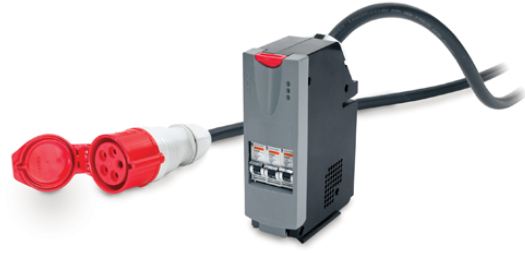
Рис. APC
Модуль для подачи питания на трехфазную нагрузку
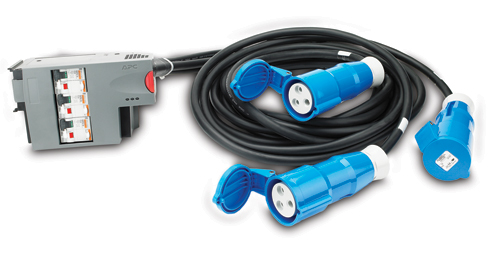
Рис. APC
Модуль для подачи питания на однофазные нагрузкиПараллельные тексты EN-RU
Factory assembled and tested Power Distribution Modules include circuit breaker, power cord, power connection, and circuit monitoring.
Собранные и проверенные на заводе-изготовиетеле модули распределения питания включают в себя автоматический выключатель, кабель, кабельную розетку и средства контроля состояния линии питания.
A variety of breaker and connector options can be chosen to supply either three-phase or single-phase power to the load.
Широкий выбор автоматических выключателей и кабельных розеток позволяет легко подобрать нужный модуль для подачи питания на трехфазные и однофазные нагрузки.
When demand rises and expansion becomes necessary, simply plug in new Power Distribution Modules. The factory-assembled modules, which include circuit breaker, power cord, and power connection, can be installed in mere minutes. There are multiple power ratings and power cord lengths for low to high power, guaranteeing compatibility and quick, easy, and convenient installation.
[APC]Когда потребляемая мощность увеличивается и необходимо расширение системы бесперебойного питания, то достаточно просто вставить новые модули распределения питания. Собранные на заводе-изготовителе модули, состоящие из автоматического выключателя, кабеля и кабельной розетки, можно установить за несколько минут. Модули поставляются на различные номинальные токи и с кабелями различной длины, что позволяет легко подобрать нужный модуль, быстро и без особого труда его установить.
[Перевод Интент]
How to install the PDM
Note: Some Power Distribution Units have filler plates installed. When a PDM is to be installed, the filler plate must be removed from the busbar.
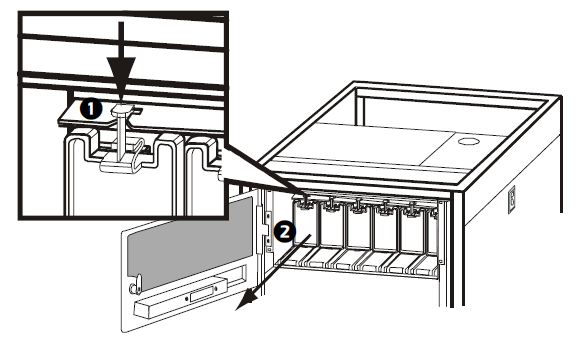
1 Press down on the clip.
2 Pull out the plate from the unit. (Do not throw away the filler plate. Keep it for potential later use).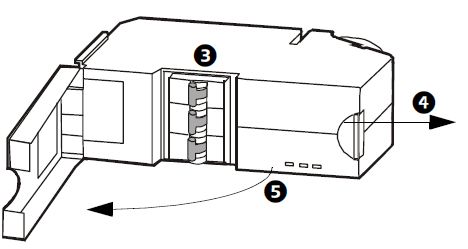
3 Verify that all the breakers are in the OFF position.
4 Press the red button to release the latch.
5 Pull open the latch.Vertical Rack Distribution Panel
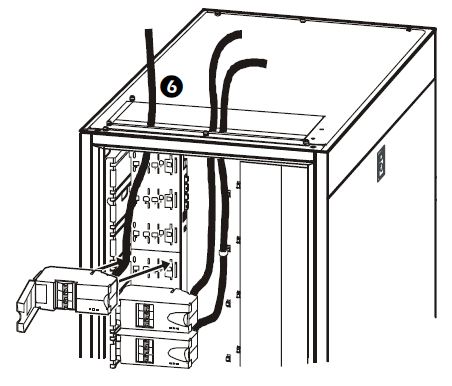
Horizontal Rack Distribution Panel
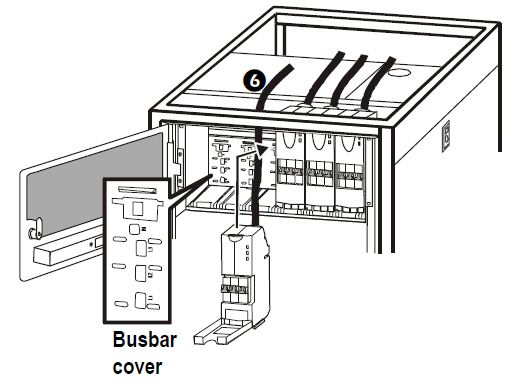
6 Feed the cable(s) up through the top opening in the enclosure and into the cable power troughs (if applicable) on top of enclosures.
How to install a PDM circuit breaker handle tie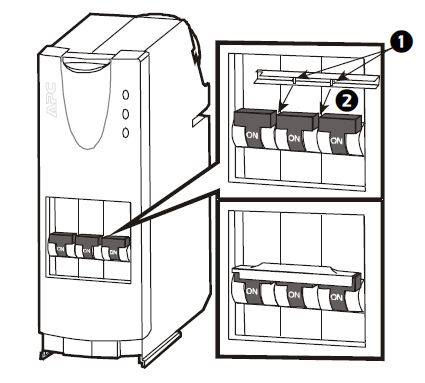
1 Locate the handle tie above the circuit breaker handles aligning the two tabs between the three handles.
2 Push the handle tie towards the circuit breaker handles until it snaps into position. Check to make sure that the handle tie is secure.
3 The handle tie can be removed by pulling it from the circuit breaker handles.Тематики
- НКУ (шкафы, пульты,...)
- источники и системы электропитания
EN
Русско-английский словарь нормативно-технической терминологии > модуль распределения питания
-
18 décaler
décaler [dekale]➭ TABLE 11. transitive verba. [+ horaire, départ, repas] ( = avancer) to bring forward ; ( = retarder) to put backb. [+ pupitre, meuble] ( = avancer) to move forward ; ( = reculer) to move back2. reflexive verb• décalez-vous d'un rang move forward (or back) a row* * *dekale
1.
1) ( dans le temps) ( avancer) to bring [something] forward [date, départ]; ( reculer) to put GB ou move US [something] backles avions sont tous décalés d'une heure — ( en retard) the planes are all taking off an hour later
2) ( dans l'espace) ( avancer) to move [something] forward [objet]; ( reculer) to move [something] backdécaler quelqu'un/quelque chose d'un rang — ( reculer) to move somebody/something back a row
2.
se décaler verbe pronominalse décaler sur la droite — to move ou shift to the right
* * *dekale vt1) [alignement, paragraphe, paramètres] to shiftDécaler l'ensemble du paragraphe vers la droite. — Shift the whole paragraph to the right.
2) [calendrier] to change3) [rendez-vous, entrevue, départ, congé] (moment, heure) to change the time of, (date) to change the date ofdécaler un rendez-vous (= reporter ou avancer) — to change the time of a meeting, (= modifier la date d'un rendez-vous) to change the date of a meeting
Il va falloir décaler notre rendez-vous.; We'll have to change the time of our meeting. — We'll have to have our meeting another time.
décaler son départ de quelques jours (reculer) — to delay one's departure by a few days, (avancer) to leave a few days earlier
* * *décaler verb table: aimerA vtr1 ( dans le temps) ( avancer) to bring [sth] forward [date, départ]; ( reculer) to put GB ou move US [sth] back; décaler le départ d'une heure ( avancer) to bring forward the departure time by one hour; les avions sont tous décalés d'une heure ( en retard) the planes are all taking off an hour later; réactions décalées delayed reactions;2 ( dans l'espace) ( avancer) to move ou shift [sth] forward [objet]; ( reculer) to move ou shift [sth] back; décaler qch de 10 centimètres ( avancer) to move ou shift sth 10 centimetresGB forward; décaler qn/qch d'un rang ( reculer) to move sb/sth back a row; poteau décalé (par rapport aux autres) post out of line (with the others); lignes décalées staggered lines.[dekale] verbe transitif1. [dans l'espace] to pull ou to shift (out of line)2. [dans le temps - horaire] to shifta. [avancé] the schedule was brought forward an hourb. [reculé] the schedule was brought ou moved one hour back3. [désorienter]————————se décaler verbe pronominal intransitifdécalez-vous d'un rang en avant/arrière move forward/back a row -
19 Women
A paradox exists regarding the equality of women in Portuguese society. Although the Constitution of 1976 gave women full equality in rights, and the right to vote had already been granted under Prime Minister Marcello Caetano during the Estado Novo, a gap existed between legal reality and social practice. In many respects, the last 30 years have brought important social and political changes with benefits for women. In addition to the franchise, women won—at least on paper—equal property-owning rights and the right of freedom of movement (getting passports, etc.). The workforce and the electorate afforded a much larger role for women, as more than 45 percent of the labor force and more than 50 percent of the electorate are women. More women than ever attend universities, and they play a larger role in university student bodies. Also, more than ever before, they are represented in the learned professions. In politics, a woman served briefly as prime minister in 1979-80: Maria de Lourdes Pintasilgo. Women are members of government cabinets ("councils"); women are in the judicial system, and, in the late 1980s, some 25 women were elected members of parliament (Assembly of the Republic). Moreover, women are now members of the police and armed forces, and some women, like Olympic marathoner Rosa Mota, are top athletes.Portuguese feminists participated in a long struggle for equality in all phases of life. An early such feminist was Ana de Castro Osório (1872-1935), a writer and teacher. Another leader in Portugal's women's movement, in a later generation, was Maria Lamas (18931983). Despite the fact that Portugal lacked a strong women's movement, women did resist the Estado Novo, and some progress occurred during the final phase of the authoritarian regime. In the general elections of 1969, women were granted equal voting rights for the first time. Nevertheless, Portuguese women still lacked many of the rights of their counterparts in other Western European countries. A later generation of feminists, symbolized by the three women writers known as "The Three Marias," made symbolic protests through their sensational writings. In 1972, a book by the three women writers, all born in the late 1930s or early 1940s (Maria Isabel Barreno, Maria Teresa Horta, and Maria Velho da Costa), was seized by the government and the authors were arrested and put on trial for their writings and outspoken views, which included the assertion of women's rights to sexual and reproductive freedom.The Revolution of 25 April 1974 overthrew the Estado Novo and established in law, if not fully in actual practice in society, a full range of rights for women. The paradox in Portuguese society was that, despite the fact that sexual equality was legislated "from the top down," a gap remained between what the law said and what happened in society. Despite the relatively new laws and although women now played a larger role in the workforce, women continued to suffer discrimination and exclusion. Strong pressures remained for conformity to old ways, a hardy machismo culture continued, and there was elitism as well as inequality among classes. As the 21st century commenced, women played a more prominent role in society, government, and culture, but the practice of full equality was lacking, and the institutions of the polity, including the judicial and law enforcement systems, did not always carry out the law. -
20 Wright, Frank Lloyd
SUBJECT AREA: Architecture and building[br]b. 8 June 1869 Richland Center, Wisconsin, USAd. 9 April 1959 Phoenix, Arizona, USA[br]American architect who, in an unparalleled career spanning almost seventy years, became the most important figure on the modern architectural scene both in his own country and far further afield.[br]Wright began his career in 1887 working in the Chicago offices of Adler \& Sullivan. He conceived a great admiration for Sullivan, who was then concentrating upon large commercial projects in modern mode, producing functional yet decorative buildings which took all possible advantage of new structural methods. Wright was responsible for many of the domestic commissions.In 1893 Wright left the firm in order to set up practice on his own, thus initiating a career which was to develop into three distinct phases. In the first of these, up until the First World War, he was chiefly designing houses in a concept in which he envisaged "the house as a shelter". These buildings displayed his deeply held opinion that detached houses in country areas should be designed as an integral part of the landscape, a view later to be evidenced strongly in the work of modern Finnish architects. Wright's designs were called "prairie houses" because so many of them were built in the MidWest of America, which Wright described as a "prairie". These were low and spreading, with gently sloping rooflines, very plain and clean lined, built of traditional materials in warm rural colours, blending softly into their settings. Typical was W.W.Willit's house of 1902 in Highland Park, Illinois.In the second phase of his career Wright began to build more extensively in modern materials, utilizing advanced means of construction. A notable example was his remarkable Imperial Hotel in Tokyo, carefully designed and built in 1916–22 (now demolished), with special foundations and structure to withstand (successfully) strong earthquake tremors. He also became interested in the possibilities of reinforced concrete; in 1906 he built his church at Oak Park, Illinois, entirely of this material. In the 1920s, in California, he abandoned his use of traditional materials for house building in favour of precast concrete blocks, which were intended to provide an "organic" continuity between structure and decorative surfacing. In his continued exploration of the possibilities of concrete as a building material, he created the dramatic concept of'Falling Water', a house built in 1935–7 at Bear Run in Pennsylvania in which he projected massive reinforced-concrete terraces cantilevered from a cliff over a waterfall in the woodlands. In the later 1930s an extraordinary run of original concepts came from Wright, then nearing 70 years of age, ranging from his own winter residence and studio, Taliesin West in Arizona, to the administration block for Johnson Wax (1936–9) in Racine, Wisconsin, where the main interior ceiling was supported by Minoan-style, inversely tapered concrete columns rising to spreading circular capitals which contained lighting tubes of Pyrex glass.Frank Lloyd Wright continued to work until four days before his death at the age of 91. One of his most important and certainly controversial commissions was the Solomon R.Guggenheim Museum in New York. This had been proposed in 1943 but was not finally built until 1956–9; in this striking design the museum's exhibition areas are ranged along a gradually mounting spiral ramp lit effectively from above. Controversy stemmed from the unusual and original design of exterior banding and interior descending spiral for wall-display of paintings: some critics strongly approved, while others, equally strongly, did not.[br]Principal Honours and DistinctionsRIBA Royal Gold Medal 1941.Bibliography1945, An Autobiography, Faber \& Faber.Further ReadingE.Kaufmann (ed.), 1957, Frank Lloyd Wright: an American Architect, New York: Horizon Press.H.Russell Hitchcock, 1973, In the Nature of Materials, New York: Da Capo.T.A.Heinz, 1982, Frank Lloyd Wright, New York: St Martin's.DY
- 1
- 2
См. также в других словарях:
Phase contrast microscopy — Phase contrast image of a cheek epithelial cell Phase contrast microscopy is an optical microscopy illumination technique of great importance to biologists in which small (invisible to the human eye) phase shifts in the light passing through a… … Wikipedia
Phase 4 Stereo — was a branch of London Records created in 1961. Phase 4 Stereo supposedly created better sound by being recorded on a 10 channel, and later 20 channel, recording console. [ [http://www.endlessgroove.com/issue4/lp4s.htm Endless Groove London Phase … Wikipedia
Phase displacement — (Elec.) A charge of phase whereby an alternating current attains its maximum later or earlier. An inductance would cause a lag, a capacity would cause an advance, in phase. [Webster 1913 Suppl.] … The Collaborative International Dictionary of English
PHASE 2 — This article is about the graffiti artist. For information on clinical trials, see Phase II clinical trials .PHASE 2 (aka Lonny Wood)George, [http://books.google.com/books?id=E1XR7Fz 7gIC pg=PA10 lpg=PA10 dq=%22phase+2%22+%22lonny+wood%22… … Wikipedia
Phase-change memory — Computer memory types Volatile RAM DRAM (e.g., DDR SDRAM) SRAM In development T RAM Z RAM TTRAM Historical Delay line memory Selectron tube Williams tube Non volatile … Wikipedia
Phase response curve — A phase response curve (PRC) illustrates the transient change in the cycle period of an oscillation induced by a perturbation as a function of the phase at which it is received. PRCs are used in various fields; examples of biological oscillations … Wikipedia
Phase-locked loop — PLL redirects here. For other uses, see PLL (disambiguation). A phase locked loop or phase lock loop (PLL) is a control system that generates an output signal whose phase is related to the phase of an input reference signal. It is an electronic… … Wikipedia
Phase Linear — articleissues unreferenced=August 2007|Phase Linear was an audio equipment manufacturer founded by Bob Carver in 1970. While primarily known as a power amplifier company it also produced several innovative preamplifers, tuners and the Andromeda… … Wikipedia
Phase 10 — Infobox Game subject name=Phase 10 image link= image caption=Cards used in Phase 10 designer=Kenneth Johnson publisher=Fundex Games players=Two to six ages= setup time=< 1 min playing time= > 3 min per hand complexity=Low strategy=Medium random… … Wikipedia
phase — noun ADJECTIVE ▪ early, first, initial, preliminary, primary ▪ start up ▪ The co op is still in the start up phase. ▪ … Collocations dictionary
Later Stone Age — Pièce bifaciale africaine datant du Later Stone Age. Le Later Stone Age (fréquemment abrégé en LSA, parfois appelé également Late Stone Age) est une phase de la Préhistoire africaine. Elle commence à des dates variables selon les régions et… … Wikipédia en Français
